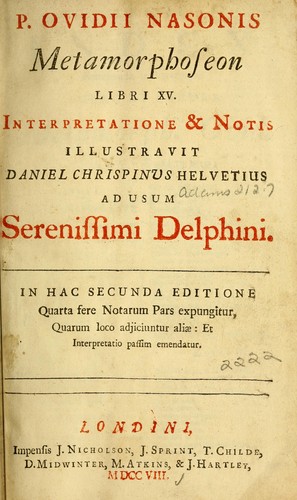
Metamorphoses
Ovid (8)
“The poem that taught Western civilization its mythology — 250 transformation stories woven into a single unbroken song from the creation of the world to the apotheosis of Julius Caesar.”
This page prints on a single page. Use Ctrl+P / Cmd+P.
Metamorphoses
Ovid (8) · 500pages · Ancient Roman / Augustan Age · 5 AP appearances
Summary
Ovid's Metamorphoses is a fifteen-book narrative poem in Latin hexameter that traces the history of the world from primordial chaos to the deification of Julius Caesar, threading together approximately 250 mythological stories through the unifying motif of transformation. Gods become animals, mortals become trees, hunters become stags, and weavers become spiders — every story pivots on a moment of irreversible change. The poem is simultaneously a compendium of Greco-Roman mythology, a subversive commentary on Augustan power, and the single most influential literary work on Western art, literature, and culture after Homer and the Bible.
Why It Matters
The Metamorphoses is, after Homer's epics and the Bible, the most influential literary work in Western civilization. It served as the primary vehicle through which classical mythology was transmitted to the medieval, Renaissance, and modern worlds. When Shakespeare wrote A Midsummer Night's Dream...
Themes & Motifs
Diction & Style
Register: Latin hexameter ranging from Virgilian grandeur to colloquial wit — the most stylistically diverse poem in classical literature
Narrator: Ovid as omniscient narrator, but an omniscience tinged with irony, sympathy, and occasional editorial commentary. Unl...
Figurative Language: Extremely high
Historical Context
Augustan Rome (27 BCE - 14 CE) — the first Roman emperor consolidating power through cultural as well as military control: Augustus demanded that art serve the state. Virgil's Aeneid provided the model: a poem that traced Rome's destiny from Troy to Augustus, validating the emperor's claim to divine ancestry and histor...
Key Characters
Talking Points
- Ovid announces a 'carmen perpetuum' — a continuous song from creation to his own time. How does this structural ambition differ from Virgil's Aeneid, and what argument about mythology and history does it imply?
- Apollo's pursuit of Daphne is often called a 'love story.' Is it? What does Ovid's language — particularly the hunting metaphors — suggest about the nature of Apollo's desire?
- Arachne's tapestry depicts gods committing sexual violence. Minerva's tapestry depicts gods punishing mortals who challenge them. Whose tapestry is 'better,' and what does Ovid's answer reveal about his view of art and power?
- Narcissus recognizes that his reflection is himself — 'Iste ego sum!' — but continues to desire it. Why does self-knowledge not break the spell? What does this say about the relationship between understanding and desire?
- Philomela's tongue is cut out, but she weaves her story into a tapestry. Why does Ovid — a poet, a man of words — give his most powerful act of artistic resistance to a visual medium rather than a verbal one?
Notable Quotes
“In nova fert animus mutatas dicere formas / corpora. (My mind is bent to tell of bodies changed into new forms.)”
“Apollo loved her, and desired to wed her; and what he desired, he hoped for.”
“If you look at it closely, you will find that it was bad luck, not guilt; for what guilt could there be in a mistake?”
Why Read This
Because every myth you half-remember — Narcissus, Icarus, Pygmalion, Medusa, Orpheus — comes from this poem. The Metamorphoses is the source code of Western mythology. But it is not a dry catalogue of myths; it is a brilliant, witty, psychological...