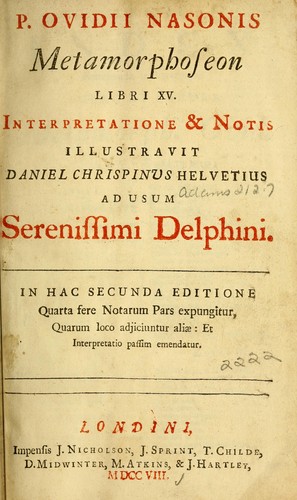
Metamorphoses
Ovid (8)
“The poem that taught Western civilization its mythology — 250 transformation stories woven into a single unbroken song from the creation of the world to the apotheosis of Julius Caesar.”
Why This Book Matters
The Metamorphoses is, after Homer's epics and the Bible, the most influential literary work in Western civilization. It served as the primary vehicle through which classical mythology was transmitted to the medieval, Renaissance, and modern worlds. When Shakespeare wrote A Midsummer Night's Dream, when Bernini sculpted Apollo and Daphne, when Titian painted Diana and Actaeon, when Kafka wrote The Metamorphosis — they were all drawing on Ovid. The poem's survival through the Middle Ages (when it was allegorized as Christian moral instruction in the Ovide moralisé) ensured that Greek and Roman mythology remained a living cultural language throughout Western history.
Firsts & Innovations
The first (and arguably only) successful attempt to synthesize the entire body of Greco-Roman mythology into a single continuous narrative
Pioneered the technique of narrative embedding — stories within stories within stories — that would become central to works from The Arabian Nights to The Canterbury Tales to Cloud Atlas
One of the earliest literary works to treat transformation of the body as a metaphor for psychological and social change — anticipating the concerns of modern identity politics, transgender studies, and body theory by two millennia
Established the ekphrasis (literary description of visual art) as a major literary mode — Arachne's tapestry, the Palace of the Sun, Pygmalion's statue set the template for centuries of art-about-art
Cultural Impact
Shakespeare drew on the Metamorphoses more than any other single source — Pyramus and Thisbe (A Midsummer Night's Dream), the storm and transformation motifs (The Tempest), Venus and Adonis (his narrative poem)
The Renaissance visual arts are inconceivable without Ovid — Botticelli, Titian, Rubens, Bernini, Velazquez, and Poussin all painted or sculpted Ovidian subjects repeatedly
Kafka's The Metamorphosis (1915) directly echoes Ovid — Gregor Samsa's transformation into an insect follows the Ovidian pattern of bodily change as social death
Ted Hughes's Tales from Ovid (1997) and Ali Smith's ongoing Seasonal Quartet demonstrate the Metamorphoses' continued generative power in contemporary literature
The psychological terms 'narcissism' and 'echo' derive directly from Ovid's Narcissus-Echo episode
Banned & Challenged
The Metamorphoses has been subject to moral anxiety since antiquity. Augustus may have used its sexual content as a pretext for Ovid's exile. Medieval Christian readers simultaneously relied on the poem as a mythological sourcebook and worried about its eroticism, producing the Ovide moralisé (14th century) — a Christianized allegorical reinterpretation. The poem's frank treatment of rape, incest (Myrrha, Byblis), same-sex desire (Orpheus, Iphis), and divine misconduct has periodically made it a target for censorship, though its canonical status in classical education has generally protected it.