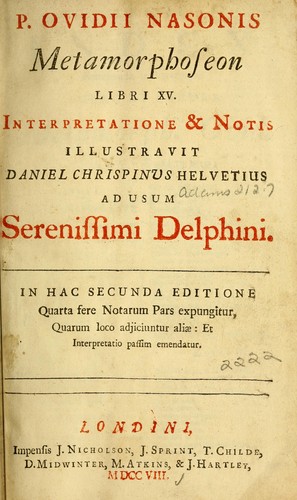
Metamorphoses
Ovid (8)
“The poem that taught Western civilization its mythology — 250 transformation stories woven into a single unbroken song from the creation of the world to the apotheosis of Julius Caesar.”
Metamorphoses— Historical Context & Author Background
Author: Ovid · Published 8· Era: Ancient Roman / Augustan Age·500 pages
Themes explored: transformation, love, power, art, nature, identity, gods-and-mortals
About Ovid
Publius Ovidius Naso (43 BCE - 17/18 CE) was born in Sulmo, east of Rome, to a prosperous equestrian family. He trained in rhetoric, briefly practiced law, then abandoned it for poetry — a decision his father lamented. Ovid became the most celebrated poet of Augustan Rome, famous for his Amores (love elegies), Ars Amatoria (The Art of Love), and Heroides (fictional letters from mythological women). The Metamorphoses, his masterwork, was completed around 8 CE — the same year Augustus exiled him to Tomis (modern Constanta, Romania) on the Black Sea. Ovid attributed his exile to 'carmen et error' — a poem and a mistake — but the specific causes remain Rome's most enduring literary mystery. He spent the last decade of his life in Tomis, writing mournful poems of exile (Tristia, Epistulae ex Ponto), begging to return. He never did. He died around 17 CE, far from Rome, but his poem conquered the world he was forbidden to inhabit.
Life → Text Connections
How Ovid's real experiences shaped specific elements of Metamorphoses.
Ovid trained in Roman rhetorical schools, mastering the arts of persuasion, argumentation, and suasoriae (speeches imagining historical figures' deliberations)
The elaborate speeches throughout the Metamorphoses — Medea's soliloquy, the Ajax-Ulysses debate, Pythagoras's discourse
Ovid's rhetorical training is visible on every page. His characters argue, persuade, and deceive with the tools of a Roman lawyer. The poem is as much a showcase of eloquence as of mythology.
His earlier works (Ars Amatoria, Amores) were witty, erotic, and subversive — they may have contributed to his exile
The Metamorphoses' ironic treatment of divine lust, its sympathy for victims of sexual violence, its refusal to treat the gods with unquestioning reverence
The same qualities that made Ovid's love poetry dangerous to Augustus animate the Metamorphoses. The poem is subversive not through direct political critique but through its refusal to treat power with appropriate solemnity.
Ovid was exiled in 8 CE, the year the Metamorphoses was completed — he reportedly ordered his manuscript burned, but copies had already circulated
The poem's epilogue, where Ovid declares that his work will survive 'Jupiter's wrath' and 'devouring age'
The epilogue reads differently knowing that Ovid was exiled by a man who styled himself as Jupiter's earthly representative. 'Neither Jupiter's wrath' is not only a literary convention — it may be a direct reference to Augustus.
He died in exile around 17 CE, never returning to Rome, convinced his literary reputation was destroyed
Orpheus's death and dismemberment — the artist destroyed by forces that cannot tolerate his song, yet whose severed head continues singing as it floats downstream
Orpheus is Ovid's self-portrait as artist-martyr. The poet can be exiled, silenced, destroyed — but the song continues. The Metamorphoses is Ovid's singing head.
Historical Era
Augustan Rome (27 BCE - 14 CE) — the first Roman emperor consolidating power through cultural as well as military control
How the Era Shapes the Book
Augustus demanded that art serve the state. Virgil's Aeneid provided the model: a poem that traced Rome's destiny from Troy to Augustus, validating the emperor's claim to divine ancestry and historical inevitability. The Metamorphoses is both a response and a challenge to this model. It includes the Aeneid's narrative (Aeneas's journey, Rome's founding) but embeds it within a vastly larger framework that relativizes Roman exceptionalism. The poem's treatment of the gods as lustful, petty, and violent implicitly undermines Augustus's claim to divine favor. Its sympathy for victims of power — Daphne fleeing Apollo, Actaeon destroyed for seeing what he shouldn't, Arachne punished for superior art — reads as veiled commentary on a regime that punished dissent.
Why Metamorphoses Matters Historically
The Metamorphoses is, after Homer's epics and the Bible, the most influential literary work in Western civilization. It served as the primary vehicle through which classical mythology was transmitted to the medieval, Renaissance, and modern worlds. When Shakespeare wrote A Midsummer Night's Dream, when Bernini sculpted Apollo and Daphne, when Titian painted Diana and Actaeon, when Kafka wrote The Metamorphosis — they were all drawing on Ovid. The poem's survival through the Middle Ages (when it was allegorized as Christian moral instruction in the Ovide moralisé) ensured that Greek and Roman mythology remained a living cultural language throughout Western history.
- The first (and arguably only) successful attempt to synthesize the entire body of Greco-Roman mythology into a single continuous narrative
- Pioneered the technique of narrative embedding — stories within stories within stories — that would become central to works from The Arabian Nights to The Canterbury Tales to Cloud Atlas
- One of the earliest literary works to treat transformation of the body as a metaphor for psychological and social change — anticipating the concerns of modern identity politics, transgender studies, and body theory by two millennia
- Established the ekphrasis (literary description of visual art) as a major literary mode — Arachne's tapestry, the Palace of the Sun, Pygmalion's statue set the template for centuries of art-about-art
The Metamorphoses has been subject to moral anxiety since antiquity. Augustus may have used its sexual content as a pretext for Ovid's exile. Medieval Christian readers simultaneously relied on the poem as a mythological sourcebook and worried about its eroticism, producing the Ovide moralisé (14th century) — a Christianized allegorical reinterpretation. The poem's frank treatment of rape, incest (Myrrha, Byblis), same-sex desire (Orpheus, Iphis), and divine misconduct has periodically made it a target for censorship, though its canonical status in classical education has generally protected it.