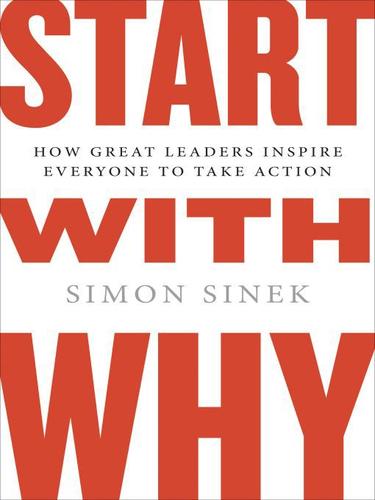
Start with Why
Simon Sinek (2009)
“A leadership thinker reveals that the most inspiring leaders and organizations — from Apple to Martin Luther King Jr. — all think, act, and communicate from the inside out, starting not with what they do but with why they do it.”
Start with Why— Historical Context & Author Background
Author: Simon Sinek · Published 2009· Era: Contemporary Nonfiction·256 pages
Themes explored: purpose, leadership, inspiration, golden-circle, loyalty, trust
About Simon Sinek
Simon Sinek (born 1973) is a British-American author, motivational speaker, and organizational consultant. He studied cultural anthropology at Brandeis University and began his career in advertising, working at agencies in New York before becoming an independent consultant. Sinek's breakthrough came with his 2009 TED Talk, 'How Great Leaders Inspire Action,' which became one of the most-watched TED Talks in history (over 60 million views). The talk presented the Golden Circle framework in a compact 18-minute format and demonstrated Sinek's exceptional ability to communicate complex ideas in simple, memorable terms. Start with Why, published the same year, expanded the TED Talk into a full-length argument. Sinek has since published several follow-up books — Leaders Eat Last (2014), The Infinite Game (2019), and Find Your Why (2017, co-authored with David Mead and Peter Docker) — each extending the Why framework into new domains. He has consulted with organizations ranging from Microsoft and the U.S. military to nonprofit organizations and schools. Sinek's background in cultural anthropology is evident in his approach — he observes patterns of human behavior across cultures and institutions and constructs narrative explanations that feel intuitively true, even when they resist rigorous empirical testing. This anthropological lens gives his work a humanistic quality that distinguishes it from more data-driven business books.
Life → Text Connections
How Simon Sinek's real experiences shaped specific elements of Start with Why.
Background in cultural anthropology at Brandeis
The book's focus on shared beliefs, tribal loyalty, and cultural patterns reflects anthropological thinking
Sinek approaches leadership as a cultural phenomenon rather than a management technique, which gives the book its distinctive humanistic flavor
Career in advertising before becoming a leadership thinker
The book's emphasis on communication — how you say what you say — reflects Sinek's advertising background
The Golden Circle is fundamentally a communication framework, and Sinek's expertise is in how messages land with audiences
TED Talk as the book's origin and proof of concept
The book reads like an expanded TED Talk — punchy, quotable, optimized for emotional impact
The TED format shaped the book's strengths (accessibility, inspiration) and weaknesses (oversimplification, limited empirical evidence)
Historical Era
Post-2008 search for meaning in business and leadership
How the Era Shapes the Book
Start with Why arrived at a moment of profound disillusionment with traditional business leadership. The 2008 financial crisis had revealed that companies optimizing for short-term profit could destroy entire economies. The millennial generation was entering the workforce with different expectations — they wanted not just a paycheck but a purpose. And the extraordinary success of companies like Apple, which seemed to succeed precisely because they were driven by purpose rather than profit, created a hunger for a framework that could explain why some organizations inspire and others merely transact. Sinek provided that framework, and its timing was perfect.
Why Start with Why Matters Historically
Start with Why introduced the Golden Circle — one of the most widely adopted frameworks in modern leadership and marketing. The phrase 'start with why' has entered the common vocabulary of business, education, and personal development, and the associated TED Talk is one of the most-viewed in history.
- Introduced the Golden Circle as a universal framework for inspirational communication
- Connected neuroscience (the limbic brain) to marketing and leadership strategy in an accessible way
- Popularized the idea that organizational purpose — not product quality or price — is the primary driver of customer loyalty
Not banned, but the book has received significant criticism for oversimplification, cherry-picked examples (Apple is used repeatedly without acknowledging counterexamples), weak neuroscience (the limbic brain mapping is metaphorical, not literal), and survivorship bias (examining only successful purpose-driven organizations while ignoring purpose-driven organizations that failed). Critics also note that reducing the civil rights movement to a communication strategy trivializes the structural, economic, and political forces involved.