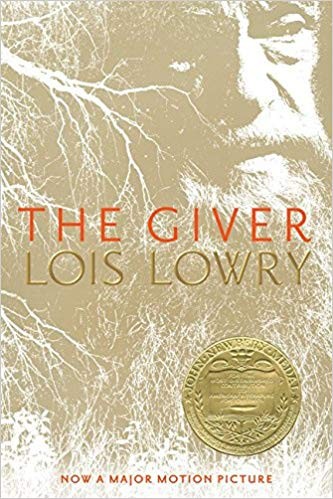
The Giver
Lois Lowry (1993)
“A society without pain is also a society without color, music, love, or the right to choose — and one boy is forced to carry all of it alone.”
This page prints on a single page. Use Ctrl+P / Cmd+P.
The Giver
Lois Lowry (1993) · 179pages · Contemporary / Dystopian Fiction · 3 AP appearances
Summary
Eleven-year-old Jonas lives in a seemingly perfect, painless community where everything is controlled — family units are assigned, emotions are suppressed with medication, and uncomfortable people are 'released.' At the Ceremony of Twelve, Jonas is selected to be the new Receiver of Memory, apprenticed to an old man called The Giver who transmits to him the suppressed memories of all human experience: color, music, snow, war, love, death. As Jonas accumulates memory, he can no longer accept his community's comfortable numbness. When he learns that 'release' means lethal injection and that a baby named Gabriel will soon be killed, Jonas flees into the unknown, hoping that the memories he carries will somehow return to the people who lost them.
Why It Matters
The Giver was the first major dystopian novel written for young readers and remains the defining text of the genre. It won the 1994 Newbery Medal and has sold more than 12 million copies. It is among the most frequently assigned books in American middle schools and among the most frequently chall...
Themes & Motifs
Diction & Style
Register: Formally flat in early chapters — institutional, procedural, nearly affectless. Gradually gains texture, color, and emotional complexity as Jonas accumulates memory. Style mirrors theme.
Narrator: Third-person limited, tightly bound to Jonas's consciousness. The narration speaks in the community's register in ear...
Figurative Language: Very low in early chapters (by design), rapidly building through the middle, reaching high density in the final sequence. Lowry's central formal argument is that figurative language
Historical Context
Published 1993 — post-Cold War, early 1990s political optimism and anxieties about conformity and state power: The Giver appeared at a moment of paradox: the Cold War had ended, and liberal democracy seemed ascendant, yet anxieties about conformity, surveillance, bioengineering, and the administrative manag...
Key Characters
Talking Points
- Lowry's prose in Chapters 1-5 is deliberately flat and nearly colorless. How does she use sentence structure, vocabulary, and the absence of sensory detail to make the community feel both comfortable and wrong?
- The community uses 'precision of language' as a moral rule. But the word 'release' — a euphemism for execution — is part of their official vocabulary. How is precision of language actually a tool of imprecision?
- Jonas's father performs lethal injections on infants and calls it release. He is not presented as a villain — he is gentle and caring. What does Lowry want us to feel about him? Is he guilty?
- The community eliminated pain — and with it, color, music, grandparents, seasons, and choice. Was the trade worth it? Use the novel's own logic to make the community's best argument, then refute it.
- Rosemary, the previous Receiver-in-training, requested her own release when the memories became too much. Jonas chooses differently. What made Jonas capable of enduring what Rosemary couldn't? Or was it just luck?
Notable Quotes
“The pilot was released. One simple mistake, and he had been released.”
“He had waited all year. Frightened was the wrong word... apprehensive, Jonas decided.”
“Rules were very important in the community. There was even a rule governing the rules: all rules must be written down.”
Why Read This
Because it asks the hardest question in a form a twelve-year-old can hold: if you could get rid of all the pain — the embarrassment, the grief, the loneliness, the fear — but you also lost color, music, love, and the right to choose anything, woul...