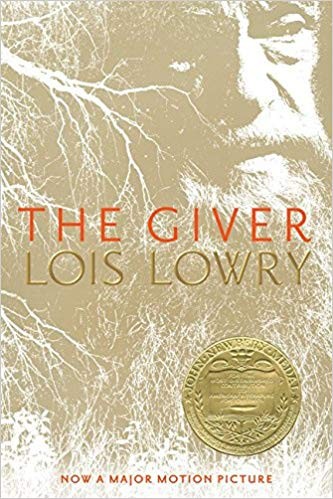
The Giver
Lois Lowry (1993)
“A society without pain is also a society without color, music, love, or the right to choose — and one boy is forced to carry all of it alone.”
Essay Questions & Food for Thought
30questions designed to challenge assumptions and provoke original thinking. These can't be answered from a summary — you need the actual text.
Lowry's prose in Chapters 1-5 is deliberately flat and nearly colorless. How does she use sentence structure, vocabulary, and the absence of sensory detail to make the community feel both comfortable and wrong?
The community uses 'precision of language' as a moral rule. But the word 'release' — a euphemism for execution — is part of their official vocabulary. How is precision of language actually a tool of imprecision?
Jonas's father performs lethal injections on infants and calls it release. He is not presented as a villain — he is gentle and caring. What does Lowry want us to feel about him? Is he guilty?
The community eliminated pain — and with it, color, music, grandparents, seasons, and choice. Was the trade worth it? Use the novel's own logic to make the community's best argument, then refute it.
Rosemary, the previous Receiver-in-training, requested her own release when the memories became too much. Jonas chooses differently. What made Jonas capable of enduring what Rosemary couldn't? Or was it just luck?
Jonas receives the memory of a battlefield and a dying soldier calling for his mother. Why does Lowry choose this specific detail — a dying boy calling for his mother — rather than describing the violence more broadly?
The ending is deliberately ambiguous — Jonas may be arriving somewhere warm and safe, or he may be dying of hypothermia and hallucinating. Does it matter which reading is correct? What does the ambiguity accomplish?
The community's daily pill suppresses 'Stirrings' — sexual feeling. The novel presents this as suppressing not just desire but the emotional texture that makes love possible. Is this a fair connection? Can you have love without desire?
Compare the community to a modern social media algorithm. Both curate experience to remove discomfort and maximize pleasant feeling. What does The Giver suggest would be lost if the algorithm succeeded completely?
The community assigns families, jobs, and spouses. The Elders claim to make better matches than individuals would make for themselves. Could they be right? What would we give up if they were?
Jonas asks his parents if they love him. They gently correct him: 'love' is too imprecise a word, too meaningless from overuse. They ask if he means do they enjoy him, are they proud of him. What has been lost in this exchange?
The community's control is described as benevolent — no one is tortured, no one starves, there are no wars. Is this genuine benevolence or is it something else? Is there a difference between a kind cage and a cruel one?
Lowry based the community's elimination of memory partly on her father's dementia — watching him lose the past and, with it, his sense of self. How does this biographical context change the way you read the novel?
The Giver plans to request release after Jonas leaves — he is planning his own death. Jonas knows this and goes anyway. Is Jonas's decision to leave selfish? Is The Giver's decision to die noble?
Orwell's 1984 uses Newspeak to control thought by limiting language. Lowry uses 'precision of language' to do the same thing. Compare the two systems. Which is more insidious and why?
The novel was published in 1993. What historical or political events might have shaped Lowry's vision of the community? Does it feel like a response to something specific?
Asher is punished as a child for imprecision of language — he gets words 'almost right.' The community treats his expressiveness as a developmental flaw. What is Lowry saying about the relationship between creativity and compliance?
The community releases the smallest of a pair of twins — keeps the larger, eliminates the smaller. What is the logic of this rule? What does it reveal about the community's deepest values?
Jonas doesn't just flee the community — he also forces it to receive its memories back by leaving. He is not asking the community for permission to give it its history back. Is this ethical?
Gabriel has the same unusual pale eyes as Jonas. The community treats this as a developmental problem. What is Lowry suggesting about the relationship between perception and difference — between seeing more and being seen as abnormal?
Brave New World (1932) also describes a society where people are kept happy through pharmaceutical management of desire and elimination of discomfort. Compare the two novels: which society is more frightening, and why?
The Giver is told entirely in third-person limited from Jonas's perspective. How would the novel be different if it were told from The Giver's perspective — from a man who has carried these memories for decades?
The community was founded by people who lived through something terrible — presumably wars, famines, environmental collapse — and chose Sameness to prevent it from happening again. Are they the heroes or the villains of the history behind this novel?
Jonas keeps the memories he receives even after transmitting them to Gabriel. Why? And why does it matter that memory can be shared without being lost?
The Giver is frequently banned for depicting euthanasia and infanticide. But the novel depicts these things as wrong. Does a book that depicts something terrible in order to condemn it deserve to be banned for depicting it?
Jonas's community has eliminated inequality — no one is rich or poor, no one starves, no one is left out. Is this genuinely good? What would you give up to live in a world where everyone was equal in this way?
Music appears at the beginning of Jonas's training (the orchestra memory) and at the end of the novel (the sound below the hill). Why does Lowry choose music as the recurring symbol of what the community surrendered?
Jonas is twelve years old. The novel asks him to make decisions that most adults never have to face. Does his age matter? Does Lowry gain or lose anything by making her protagonist a child rather than an adult?
The Giver says the community 'gained control of many things but had to let go of others.' Is this an accurate description? Or is it a euphemism the old man uses to make a tragedy sound like a trade?
Write the scene The Giver does not write: what happens in the community the morning after Jonas leaves, when the memories begin to return? What do the people feel? What does Jonas's father feel when he understands, for the first time, what release means?