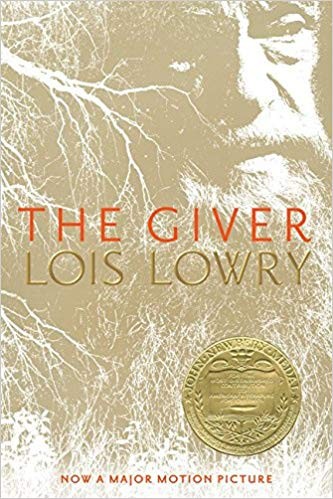
The Giver
Lois Lowry (1993)
“A society without pain is also a society without color, music, love, or the right to choose — and one boy is forced to carry all of it alone.”
The Giver— Historical Context & Author Background
Author: Lois Lowry · Published 1993· Era: Contemporary / Dystopian Fiction·179 pages
Themes explored: memory, freedom, conformity, pain, sacrifice, innocence, dystopia, choice
About Lois Lowry
Lois Lowry (born 1937) is one of the most decorated American children's and young adult authors, winner of two Newbery Medals (for Number the Stars in 1990 and The Giver in 1994). The Giver emerged from converging sources of grief and observation. Her father, Robert Hammersberg, developed senile dementia in his later years, and Lowry watched him lose his memories — losing his past meant losing, in important ways, his self. She was fascinated and disturbed by what disappears when memory goes. Separately, her son Grey, an Air Force pilot, was killed in a 1995 plane crash (after the novel's publication, but the years of his military service and the awareness of mortality it carried influenced the period during which she was writing). The Giver was also shaped by Lowry's experience visiting her elderly father in a nursing home and watching him look at a family photograph he no longer recognized — a moment she has cited as the emotional seed of the novel.
Life → Text Connections
How Lois Lowry's real experiences shaped specific elements of The Giver.
Lowry's father's dementia erased his memories and, with them, his sense of self and history
The community has done collectively what dementia does individually — removed memory to remove pain, and in doing so removed identity
The Giver is a political novel about dementia writ large: what is lost when we choose, or are forced, to forget. Lowry knows this loss from intimate experience.
Lowry visited her father in a care facility and watched him fail to recognize his own family photograph
The House of the Old, where Jonas volunteers; the elderly who have no memories of family because family bonds were not maintained across generations
The institutional care of the elderly in the community is not cruel — it is comfortable and managed — but it produces the same isolation Lowry witnessed: people who have lost the thread back to who they were.
Lowry's interest in what societies choose to forget — collective amnesia as political act
The community's founding choice to eliminate memory as a condition of eliminating pain
Lowry is asking the question political scientists ask about how nations process historical atrocity: if we could forget the worst of the past, should we? The community's answer is yes. The novel's answer is no.
Her son Grey's Air Force service and awareness of military sacrifice
The battlefield memory Jonas receives — the dying soldier, war's reality — and the community's decision to eliminate war by eliminating the memory of it
The novel refuses to romanticize what the community eliminated. War was real and terrible. But the community's solution — remove the memory — also removes the understanding that makes peace meaningful.
Historical Era
Published 1993 — post-Cold War, early 1990s political optimism and anxieties about conformity and state power
How the Era Shapes the Book
The Giver appeared at a moment of paradox: the Cold War had ended, and liberal democracy seemed ascendant, yet anxieties about conformity, surveillance, bioengineering, and the administrative management of human life were intensifying. Lowry was not writing about Soviet totalitarianism — she was writing about benevolent managerialism, the threat of a society so committed to comfort and efficiency that it optimizes away everything that makes life worth living. This makes the novel more unsettling than dystopias set in obviously evil regimes: the community is not cruel. It is kind. And that kindness is the problem.
Why The Giver Matters Historically
The Giver was the first major dystopian novel written for young readers and remains the defining text of the genre. It won the 1994 Newbery Medal and has sold more than 12 million copies. It is among the most frequently assigned books in American middle schools and among the most frequently challenged — a combination that makes it a cultural flashpoint about what children should be allowed to read and think. Its exploration of euthanasia, infanticide, and the limits of state power remains as controversial in 2026 as it was in 1994.
- First widely read dystopian novel written for a middle-grade audience — established the template for The Hunger Games, Divergent, and subsequent YA dystopia
- One of the first YA novels to depict state-administered euthanasia with full moral clarity and without softening
- Pioneered the use of prose style itself as a thematic argument — the flatness of the early chapters IS the critique
Consistently among the most challenged and banned books in American school libraries. Common objections: depictions of euthanasia (infant and elderly), violence (the battlefield memory, the baby's injection), sexual content (the Stirrings dream), and — most revealingly — the portrayal of a seemingly good society as dystopian, which some communities have read as an attack on stability and order. The irony that the novel's premise is the banning of dangerous thought has not gone unremarked.