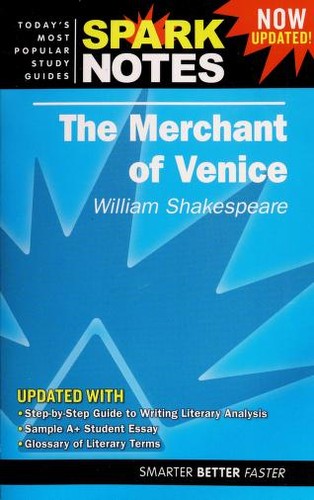
The Merchant of Venice
William Shakespeare (1600)
“A pound of flesh, a courtroom disguise, and the question Western literature still cannot answer: is Shylock a villain or a victim?”
Essay Questions & Food for Thought
30questions designed to challenge assumptions and provoke original thinking. These can't be answered from a summary — you need the actual text.
Portia's mercy speech argues that mercy 'droppeth as the gentle rain from heaven.' Yet when Shylock refuses mercy, Portia shows none. Is the speech sincere, or is it a legal tactic — an offer she knows Shylock will refuse, setting up the kill?
Shakespeare gives Shylock the play's most eloquent defense of shared humanity ('Hath not a Jew eyes?') and then has him demand a pound of human flesh. Why does he put these two things in the same character? What is he doing to the audience?
The casket test rewards the suitor who chooses lead — who 'must give and hazard all he hath.' But Bassanio hazards nothing of his own: his courtship is funded by Antonio's flesh. Does this undermine his choice, or does it not matter?
Shylock says 'I am content' when ordered to convert to Christianity. What is in those two words? Defeat? Despair? Relief? Numbness? How should an actor deliver them, and why?
Jessica steals her father's money AND her dead mother Leah's ring, which she trades for a monkey. Is Jessica a liberating figure escaping oppression, or a betrayer whose theft triggers the play's tragedy? Can she be both?
Antonio's condition for sparing Shylock's life is that Shylock must convert to Christianity. Antonio frames this as mercy. Is it? What does forced conversion mean when your identity is your faith?
Venice needs Shylock's money but despises his religion. Antonio borrows from a man he has publicly abused. How does the play dramatize the hypocrisy of a society that uses the people it persecutes?
Act Five takes place in Belmont with moonlight and music and lovers reunited. Shylock is never mentioned. What is Shakespeare doing by ending the comedy in a place where the play's most complex character does not exist?
Compare Shylock's demand for his bond to a modern contract dispute where the legal outcome is technically correct but morally repugnant. When is enforcing the letter of the law an act of injustice?
Portia says 'The quality of mercy is not strained' — it cannot be forced. But the trial's outcome is that Shylock is forced to convert. How does the play's treatment of mercy contradict its own most famous speech?
Is The Merchant of Venice an antisemitic play, or a play about antisemitism? What is the difference, and does the distinction hold?
Lorenzo and Jessica open Act Five with a game of mythological references — Troilus and Cressida, Pyramus and Thisbe, Dido and Aeneas. Every example is a story of doomed love. Why does Shakespeare fill the romantic finale with stories of betrayal?
Compare Shylock to Othello. Both are outsiders in Venice — tolerated for their usefulness, destroyed when they assert themselves. What does Venice do to the people it needs but does not accept?
Gratiano taunts Shylock throughout the trial with open cruelty. Why does Shakespeare include a character who says the quiet part loud? What does Gratiano reveal about the Christian community?
The bond specifies 'a pound of flesh' but not blood. Portia uses this technicality to defeat Shylock. Is this brilliant legal reasoning or a rigged game? Could any bond survive this kind of reading?
Shylock's 'Hath not a Jew eyes' speech begins as a plea for shared humanity and ends as a promise of revenge. Map the speech's logical structure. Where exactly does it pivot, and why?
Antonio is the title character but has no clear motive, no romantic partner, and no dramatic arc beyond offering his body. Why does Shakespeare name the play after the least active major character?
Compare Portia's legal strategy to a prosecutor who wins on a technicality. Is she admirable or frightening — or both? What does her victory tell us about who controls the law?
The play was staged in Nazi Germany as antisemitic propaganda. It has also been staged as a critique of antisemitism. Can the same text support both readings? What does that tell us about how literature works?
Bassanio gives away Portia's ring on the same day he swore to keep it. Portia gave it as a test of loyalty. What does the ring plot tell us about trust, oaths, and the difference between words and actions?
Shylock's daughter converts to Christianity and his wealth goes to Christian heirs. From a 16th-century Christian perspective, this is a happy ending — a soul saved. From a modern perspective, it looks like cultural genocide. How do you hold both readings?
Compare Shylock's forced conversion to any modern instance where a legal system imposes the dominant culture's values on a minority. What structural parallels exist?
The play never shows us Shylock's life after the trial. He exits saying 'I am not well.' Imagine his next scene. What would it contain? Why does Shakespeare deny it to us?
Compare The Merchant of Venice to To Kill a Mockingbird. Both feature a trial where the legal system reveals a community's prejudices. How does each play/novel use the courtroom to expose what the community will not say openly?
Portia is bound by her dead father's will — she cannot choose her own husband. She then goes to Venice and controls the outcome of the trial. How does the play treat female power? Where is Portia powerful and where is she powerless?
The phrase 'pound of flesh' has entered common English to mean an unreasonable demand. But is Shylock's demand unreasonable? Antonio agreed to the bond. The law supports it. What makes a legal claim feel excessive?
Compare the mercy speech in The Merchant of Venice to the 'to be or not to be' soliloquy in Hamlet. Both are among Shakespeare's most famous passages. How does each function in its play — as sincere belief, as performance, or as something more complicated?
Shylock says the Christians taught him villainy. Antonio has spat on him. Venice has confined him to a ghetto. Does the play suggest that Shylock's cruelty is caused by Christian cruelty, or that it exists independently? What is at stake in each reading?
Compare Shylock to Atticus Finch's client Tom Robinson. Both are members of persecuted minorities facing a legal system controlled by the majority. How does each text use the trial to reveal the limits of law as a vehicle for justice?
If you were directing The Merchant of Venice today, how would you stage the trial scene? Would you play Shylock as villain, victim, or both? Would the audience leave the theater comfortable or disturbed? Justify your choices with specific textual evidence.