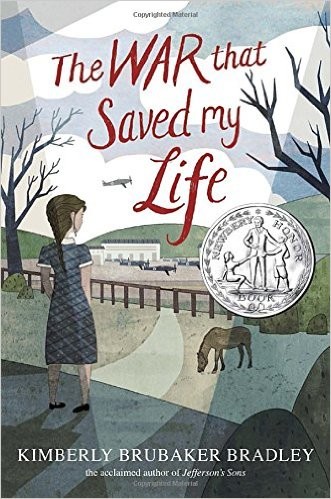
The War That Saved My Life
Kimberly Brubaker Bradley (2015)
“For one girl trapped in a London flat by her own mother, World War II is not a catastrophe — it is an escape.”
The War That Saved My Life— Historical Context & Author Background
Author: Kimberly Brubaker Bradley · Published 2015· Era: Contemporary·316 pages
Themes explored: abuse, freedom, disability, self-worth, war-as-liberation
About Kimberly Brubaker Bradley
Kimberly Brubaker Bradley is an American author of children's and young adult fiction. She has spoken about being inspired by the real history of British child evacuation during WWII, and about wanting to explore what it would mean for a child to find war liberating rather than traumatic. The novel was a Newbery Honor book in 2016 and spent years on bestseller lists. A sequel, The War I Finally Won, was published in 2017.
Life → Text Connections
How Kimberly Brubaker Bradley's real experiences shaped specific elements of The War That Saved My Life.
Bradley researched the WWII British evacuation program extensively, including firsthand accounts from evacuees
The evacuation scenes are rendered with historical specificity — the tags, the trains, the billeting process
The historical accuracy grounds Ada's personal story in a real, documented event, lending it moral authority.
Bradley has spoken about wanting to write a story where war is not the worst thing that happens to a child
The novel's central irony: Ada's home life is worse than the war. Evacuation is liberation, not displacement.
This inversion of the typical war narrative forces readers to reconsider assumptions about safety and danger.
Bradley has written about disability in other novels and has advocated for authentic representation of physical disability in children's literature
Ada's clubfoot is treated with medical accuracy and never presented as a metaphor or a character flaw
The novel insists that disability is a fact, not a meaning. Ada's foot is a condition; shame is a choice.
Historical Era
World War II Britain — evacuation, the Blitz, rural England
How the Era Shapes the Book
The evacuation program accidentally exposed the living conditions of Britain's poorest children. When evacuees arrived in countryside homes — malnourished, uneducated, often abused — rural communities were shocked. Ada's story is a heightened version of a real phenomenon: war revealing what peace had hidden. The historical context gives the novel's themes of captivity and liberation a concrete framework that is both personal and national.
Why The War That Saved My Life Matters Historically
Newbery Honor (2016). One of the most acclaimed middle-grade historical fiction novels of the 2010s. Praised for its unflinching treatment of child abuse, its complex portrayal of disability, and its inversion of the typical war narrative. Widely taught in schools for its historical content and its themes of resilience and self-worth.
- One of the first major middle-grade novels to present WWII from the perspective of a child for whom war is liberation
- Pioneered a psychologically realistic portrayal of child abuse recovery in middle-grade historical fiction
- Among the first widely-read children's novels to treat clubfoot with medical accuracy rather than as metaphor
Occasionally challenged for its depiction of child abuse and its complex moral stance on war. Some parents have expressed concern about the portrayal of a mother as an abuser. Generally well-received by schools and libraries.