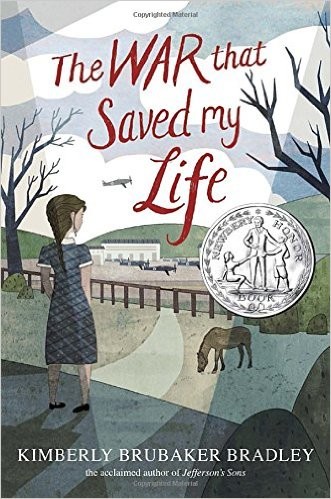
The War That Saved My Life
Kimberly Brubaker Bradley (2015)
“For one girl trapped in a London flat by her own mother, World War II is not a catastrophe — it is an escape.”
Essay Questions & Food for Thought
30questions designed to challenge assumptions and provoke original thinking. These can't be answered from a summary — you need the actual text.
The title says the war 'saved' Ada's life. How can a war save someone? What does this title say about the relationship between large-scale catastrophe and individual liberation?
Ada's clubfoot is described medically rather than metaphorically. Why does Bradley insist on clinical accuracy? How would the novel change if the foot were treated as a symbol?
Mam is not presented as a cartoon villain. She is poor, ashamed, and socially pressured. Does understanding her motivations make her less culpable? Should it?
Ada describes her life in the flat without self-pity. Why is this more effective than if she had described it with outrage or sadness?
When the doctor says Ada's foot was always treatable, what does this revelation mean for Ada's understanding of her own life? How does it change her relationship with Mam?
Susan and Ada are both grieving — Susan for Becky, Ada for her lost childhood. How does shared grief bring them together, and how does it drive them apart?
Ada discovers that she is a skilled horseback rider. Why is this discovery so important for her sense of self? What does riding give her that walking cannot?
The novel is set during WWII but is not really about the war. What is it about? How does Bradley use the historical setting without making it the primary subject?
Ada tests Susan repeatedly — behaving badly to provoke rejection. Why do abused children test their caregivers? What is Ada trying to prove?
Compare Ada's escape from the flat to a prisoner's escape from jail. What does Ada's story say about the difference between physical freedom and psychological freedom?
The billeting officer assigns Ada and Jamie to Susan because no one else will take them. What does this accidental placement say about how chance shapes our lives?
Ada wants the war to continue because the war keeps her safe from Mam. Is this a selfish wish? Can a wish be both understandable and morally troubling?
How does Bradley portray the British class system through the evacuation? What happens when working-class London children meet middle-class country families?
Susan's relationship with Becky is never fully explained. Why does Bradley leave this ambiguous? What does the ambiguity add to the novel?
Ada says Susan 'held the door open' but Ada 'walked through it myself.' Why does Ada insist on her own agency? Why is this distinction important?
How does the novel define 'home'? Ada's flat was never home despite being where she lived. What makes a place home?
The novel could have been told from Susan's perspective. Why does Bradley choose Ada's point of view? What would change if Susan narrated?
Jamie adjusts to the countryside more easily than Ada. What does this difference reveal about how age and experience shape our ability to adapt?
The novel ends with Ada looking out a window — the same gesture that opened the book. How has the meaning of the window changed?
Ada learns to read during her time with Susan. How does literacy change Ada's relationship with the world? What does reading give her beyond information?
Compare this novel to Number the Stars. Both are WWII middle-grade novels. How do they differ in their treatment of war, courage, and childhood?
Ada's surgery improves her foot but does not cure it. Why is Bradley's choice not to fully 'fix' Ada important?
Why does Mam arrive to reclaim her children? Does she love them, or does she need them for something else?
The community rallies behind Ada during the custody dispute. What role does community play in protecting vulnerable children? Can one person do what a community cannot?
Ada was never allowed to go to school. When she finally attends, she is years behind her peers. How does educational deprivation compound other forms of abuse?
How does the novel use food? Ada arrives at Susan's malnourished. Meals become a recurring marker of care. What does food represent in this story?
The sequel is called The War I Finally Won. What 'war' might Ada still be fighting after the events of this novel?
Ada says she did not know she was a person until she left the flat. Can a person not know they are a person? What does personhood require?
Why does Bradley set the novel in the early months of WWII rather than later in the conflict? How does the timing affect Ada's story?
If Ada's story happened today — a child locked in an apartment for a decade — what systems would (or should) intervene? Has society improved at detecting and preventing this kind of abuse?