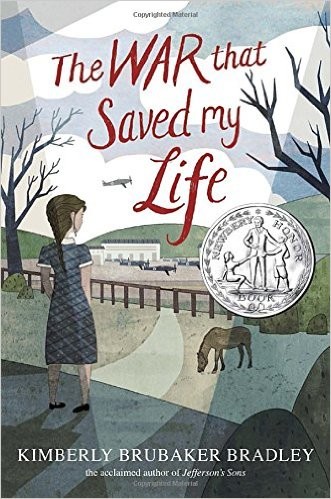
The War That Saved My Life
Kimberly Brubaker Bradley (2015)
“For one girl trapped in a London flat by her own mother, World War II is not a catastrophe — it is an escape.”
Language Register
Informal, first-person, working-class London voice filtered through a child's perspective
Syntax Profile
Short, declarative sentences reflecting Ada's limited education and emotional guardedness. Ada speaks like someone who has been trained to take up as little space as possible — even her language is compressed. As she gains confidence, her sentences lengthen slightly, but the voice remains fundamentally spare.
Figurative Language
Very low — Ada does not think in metaphor because her experience has been too literal. When figurative language appears, it is physical rather than abstract: riding as flying, the flat as a cage. The plainness of the prose is a stylistic choice that mirrors Ada's constrained worldview.
Era-Specific Language
Working-class British term for mother — also the name of Ada's captor, making the word itself carry double weight
The WWII program that relocated children from British cities to the countryside
Officials who assigned evacuated children to host families — the bureaucracy that accidentally saved Ada
Congenital deformity — the novel insists on the medical term rather than Mam's shaming language
German bombing campaign against British cities — the backdrop of Ada's liberation
How Characters Speak — Class & Identity
Ada
Working-class London dialect, limited vocabulary, no literary register. Gains words for new experiences as the novel progresses.
A mind that has been denied education but not intelligence. Ada's limited vocabulary is a function of deprivation, not capacity.
Susan
Educated, measured, somewhat formal. Shorter sentences when grieving. Longer sentences when engaged.
A woman who retreats into precision when emotional, using language as a wall.
Mam
Sharp, cruel, monosyllabic. Uses words as weapons — 'ugly,' 'useless,' 'shame.'
A person whose vocabulary for her own child is entirely negative. The language of abuse is a language of reduction.
Narrator's Voice
Ada Smith: first-person, past-tense, plain and unadorned. Her voice is the voice of someone who has been told she does not matter, learning — word by word, experience by experience — that she does.
Tone Progression
The flat
Flat, resigned, clinical
Ada describes abuse without drama because she does not know it is abuse.
The countryside
Wondering, suspicious, tentatively hopeful
New experiences flood in. Ada cannot trust them but cannot resist them either.
Confrontation and resolution
Fierce, self-possessed, quietly triumphant
Ada finds her voice — not loud, but firm. She knows who she is.
Stylistic Comparisons
- The One and Only Ivan by Katherine Applegate — similarly spare first-person captivity narrative, but Ivan's constraints are physical where Ada's are psychological
- Number the Stars by Lois Lowry — another WWII middle-grade novel, but Lowry's protagonist has agency from the start; Ada must discover hers
- A Long Walk to Water by Linda Sue Park — similarly direct prose documenting survival under extreme conditions, both refusing to sentimentalize suffering
Key Vocabulary from This Book
Notable words used in this text — click to see full definitions