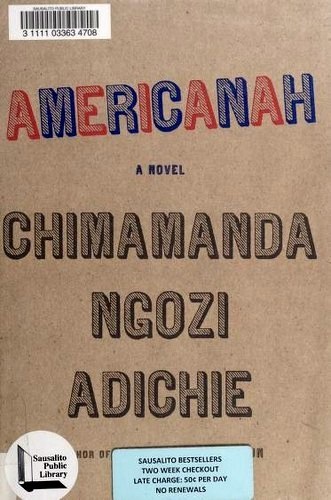
Americanah
Chimamanda Ngozi Adichie (2013)
“A Nigerian woman moves to America and discovers that race is not something you are born with — it is something America assigns to you.”
Americanah— Historical Context & Author Background
Author: Chimamanda Ngozi Adichie · Published 2013· Era: Contemporary·477 pages
Themes explored: race, immigration, identity, love-obsession, class, belonging, code-switching, authenticity
About Chimamanda Ngozi Adichie
Chimamanda Ngozi Adichie was born in 1977 in Enugu, Nigeria, and grew up in Nsukka, where her father was a professor at the University of Nigeria and her mother was the university's first female registrar. She left Nigeria at nineteen for the United States, studying at Drexel University then Eastern Connecticut State University, and eventually completing an MFA and an MA. Like Ifemelu, she has spent years moving between Nigeria and America, and like Ifemelu, she was 'not Black' before she came to America. Americanah is explicitly autobiographical in its structure if not its specific events.
Life → Text Connections
How Chimamanda Ngozi Adichie's real experiences shaped specific elements of Americanah.
Adichie left Nigeria at nineteen and experienced American race categories as a newcomer
Ifemelu's experience of discovering she is 'Black' in America — a category that didn't exist for her in Nigeria
The novel's central insight is experiential, not theoretical. Adichie isn't writing about race from research; she's writing from the specific disorientation of being assigned a new identity.
Adichie's TED talk 'The Danger of a Single Story' and 'We Should All Be Feminists' demonstrate the same direct, aphoristic public voice
Ifemelu's blog posts, which use the same direct-address, aphoristic style as Adichie's non-fiction
The blog isn't a fictional device imposed from outside — it's Adichie's own voice, transplanted into the novel as a character trait. Ifemelu's blog is Adichie's essay writing.
Adichie has spoken about returning to Nigeria after long American absences and feeling simultaneously at home and foreign
Ifemelu's reverse culture shock in the Lagos return sections
The return chapters' emotional texture — the untranslatable feeling of being foreign in your own country — requires lived experience. This is not something that can be researched.
Adichie grew up during Nigeria's military dictatorships and university strike culture
The Lagos background of political instability, university strikes, and the push to emigrate
The immigration is not presented as economic desperation but as educated-class flight from a system that has closed its futures — a specific political experience.
Historical Era
1990s-2013 — post-military Nigeria, post-9/11 America, Obama era
How the Era Shapes the Book
The novel is historically precise — 9/11 changes which characters can get visas and shapes their entire trajectories. Obama's campaign appears in a blog post with the specificity of a person who was there. The natural hair movement is a political backdrop to Ifemelu's choices about her own hair. Adichie is writing a novel set in a specific moment, not an evergreen immigrant story.
Why Americanah Matters Historically
Won the National Book Critics Circle Award for Fiction in 2013. One of the most significant novels about race in America written in the 21st century — and the one with the most unusual authority: a non-American Black woman who can see American race from outside the categories Americans take for granted. Often taught alongside Ta-Nehisi Coates's Between the World and Me as complementary perspectives on American Blackness.
- First major literary novel to use a blog-within-novel device as a primary thematic and structural element
- One of the first widely-taught novels to explicitly distinguish between African-American and Non-American Black experience as different historical phenomena
- Brought the concept of 'code-switching' — previously a sociolinguistic term — into mainstream literary and cultural discussion
Challenged in several Texas school districts for sexual content and for what critics called 'divisive' treatment of race — a charge that rather proves the novel's point about American discomfort with direct racial discourse.