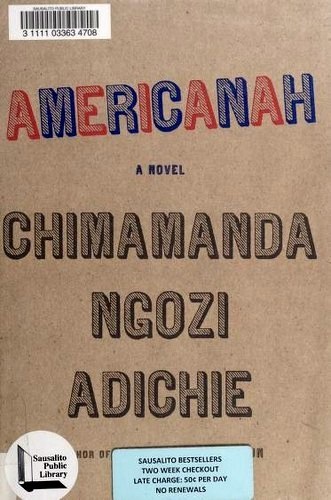
Americanah
Chimamanda Ngozi Adichie (2013)
“A Nigerian woman moves to America and discovers that race is not something you are born with — it is something America assigns to you.”
Americanah— Summary & Analysis
by Chimamanda Ngozi Adichie · published 2013 · 477 pages · Contemporary
A user-friendly study guide for Americanah by Chimamanda Ngozi Adichie (2013): a high-level plot summary, full chapter-by-chapter analysis, theme breakdowns, character profiles, and 30 essay questions designed for ap-english, college readers. Unlike a stock summary, sumsumsum.com adds a diction analysis drawn from Chimamanda Ngozi Adichie’s actual text, the 3 documented AP Literature exam appearances of this book, and reading-difficulty guidance (Easy, 2/10) so students, teachers, and lifelong readers know what they are walking into.
“A Nigerian woman moves to America and discovers that race is not something you are born with — it is something America assigns to you.”
Short Summary
Ifemelu, a young Nigerian woman, immigrates to the United States for college and builds a life while maintaining a long-distance relationship with her childhood sweetheart Obinze. America forces her to confront race for the first time — she wasn't 'Black' in Nigeria. She becomes a successful blogger writing about race through an outsider's eyes, dates an African-American man and then a wealthy white man, and eventually returns to Lagos, where Obinze — now married and wealthy — still waits for her, impossibly.
Detailed Summary
The novel opens in a hair braiding salon in Trenton, New Jersey, where Ifemelu is getting her hair done before returning to Nigeria after thirteen years in America. The long hours of braiding become the frame for her story, told in flashback. Ifemelu and Obinze met as teenagers in Lagos, in seconda...
Summary in the Author’s Writing Style
A retelling of Americanah in Chimamanda Ngozi Adichie’s style — so you can hear the language, not just the plot. This is a stylistic pastiche written by sumsumsum, not an excerpt from the book.
In the braiding salon in Trenton, where the air conditioner leaked and the woman named Aisha asked too many questions, Ifemelu sat with her scalp tugged into rows and let thirteen years arrange themselves behind her eyes. She was going home. The word still surprised her, how easily it had come, afte…
Chapter-by-Chapter Analysis
If you liked Americanah, read next
Start with Invisible Man by Ralph Ellison — The Black outsider using his visibility-as-invisibility to see American race clearly — Ellison goes surreal and symbolic; Adichie stays realist; both are about what America does to a self that arrived with a different one. Then try Open City by Teju Cole — Nigerian-American narrator's walking meditation through New York — Cole is more interior and formally modernist, Adichie more socially wide-angle; both are Nigerian writers using the outsider's eye on America. Or pivot to Native Son by Richard Wright — The African-American experience of racial assignment from inside — a useful comparison to Americanah's immigrant perspective; together they show two different sides of being Black in America.
For comparative essays, pair Americanah with
The strongest comparative pairing is White Teeth (Zadie Smith) — Multi-generational immigrant novel about identity and belonging in the Anglophone world — Smith is more formally playful; Adichie is more architecturally controlled, but both use humor as a vehicle for serious argument. Another productive pairing is The Namesake (Jhumpa Lahiri) — Indian immigrant family in America across two generations — where Adichie is politically direct, Lahiri is intimate and domestic, but both track the specific costs of hyphenated identity. For a third angle, contrast with The Bluest Eye (Toni Morrison) — Black beauty standards and the internalization of white aesthetic norms — Morrison is more formally experimental; Adichie more novelistically linear; both interrogate what happens when a culture's beauty ideal excludes its own members.
Each of these pairings opens a clean thesis path on shared themes, period diction, or formal influence — useful for AP Lit / IB / first-year college comparative essays.
More from Chimamanda Ngozi Adichie and the scholars who study Adichie
Other works by Chimamanda Ngozi Adichie: Half of a Yellow Sun (2006, 433 pages), Purple Hibiscus (2003, 307 pages). Reading two or three of these in sequence reveals Chimamanda Ngozi Adichie’s recurring obsessions and stylistic signatures more clearly than any single book can.