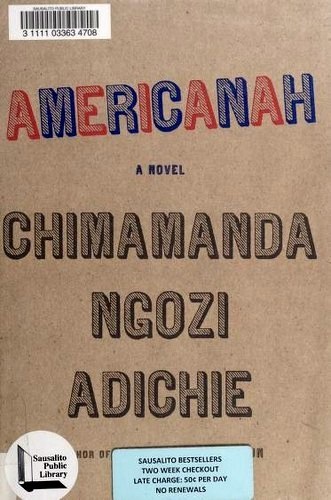
Americanah
Chimamanda Ngozi Adichie (2013)
“A Nigerian woman moves to America and discovers that race is not something you are born with — it is something America assigns to you.”
Language Register
Mixed — novelistic narration shifts between warm and analytic; blog posts are deliberately direct and aphoristic; dialogue is character-specific and often code-switches between registers
Syntax Profile
Adichie's sentences are mid-length and precise — neither Fitzgerald's rolling cadences nor Hemingway's staccato. Her narration favors concrete specificity over abstraction: she names brands, neighborhoods, prices. The blog posts use numbered lists, direct address, and aphorism — a structurally different syntax from the narration, deployed to create contrast between Ifemelu's public and private voices.
Figurative Language
Moderate — Adichie is more likely to find the exact concrete image than to deploy metaphor. Her most striking figures are social observations elevated to aphorism ('her voice is full of money' equivalent: Adichie gives us specific behavioral detail instead of a single devastating metaphor).
Era-Specific Language
Adichie's coinage for African/Caribbean immigrants who are categorized as Black in America but don't carry the specific history of American anti-Black racism
Nigerian slang for a Nigerian who has returned from America and performs Americanness — affected accent, changed mannerisms, slightly contemptuous of Nigeria
Chemical hair straightening — political shorthand in the novel for Black women's relationship to white beauty standards
National Association of Nigerian Students — the university politics that backdrop the Lagos chapters
Nigerian term for a wealthy, influential man — appears when Obinze becomes wealthy
How Characters Speak — Class & Identity
Ifemelu
Three registers: Nigerian-English (home), performed American-English (early America), and eventually a hybrid that is consciously her own. The blog is a fourth register — public, rhetorical, aphoristic.
Identity as active construction. Ifemelu is always choosing which self to present. The novel's arc is her moving toward a self that doesn't require the choice.
Obinze
Consistently one register — articulate, direct, without performance. His speech is the same in Lagos, in England, and at wealthy Lagos dinner parties.
Self-possession as a form of freedom. Obinze's inability to perform is what makes him attractive and also what makes his comfortable Lagos life a kind of trap.
Kosi
Lagos elite social English — beautifully maintained, warm without being fully open, the language of a woman who has optimized for the life she chose.
Social competence is not authenticity. Kosi's language is impeccable and reveals almost nothing about her inner life — which may be Adichie's point.
Aunty Uju
Shifts register dramatically — professional Nigerian-English, then performed American-English, then a hybrid that satisfies neither. She instructs her son Dike to speak 'proper' American English.
The immigrant parent's dilemma: the performance she teaches her child costs the child his relationship to himself.
Blaine
Academic-American — careful, argued, conscious of language as political. He corrects himself and others. The precision is both a strength and a limitation.
American racial politics has its own language, and fluency in it can become a form of gatekeeping. Blaine's precision about language is also a precision about who belongs in the conversation.
Narrator's Voice
Close third-person, alternating between Ifemelu and Obinze. Warm but not sentimental, with the occasional flash of direct address that is quickly pulled back. Adichie's narrator is the most socially intelligent presence in the room — it sees what the characters cannot see about themselves. The blog posts break into this narration as a formally distinct second voice.
Tone Progression
Lagos (chapters 1-2)
Warm, specific, nostalgic without sentimentality
The world Ifemelu is leaving — rendered with enough love to make the loss legible.
America arrival (chapters 3-5)
Wary, observational, occasionally funny, occasionally devastating
The outsider's eye is sharpest when the outsider is most disoriented. The comic and the painful alternate rapidly.
Blog and relationships (chapters 6-8)
Sharp, analytic, with underneath-current of loneliness
Success and alienation simultaneously. The blog voice becomes increasingly confident as Ifemelu herself becomes increasingly uncertain of who she is for.
Obinze in Lagos (chapter 9)
Quiet, melancholic, suspended
The man who had everything — rendered in the prose of someone who has stopped expecting anything.
Return and reunion (chapters 10-11)
Complex, suspended, restrained
Adichie refuses the easy emotional resolution. The ending is honest precisely because it doesn't complete the arc cleanly.
Stylistic Comparisons
- Zadie Smith's White Teeth — another immigrant novel about race and identity in the Anglophone world, but Smith is more formally chaotic; Adichie is more architecturally controlled
- Ralph Ellison's Invisible Man — also uses a Black outsider perspective to expose the mechanisms of American racism; Ellison goes surreal, Adichie stays realist
- Teju Cole's Open City — similar intellectual traveler's gaze; Cole is more interior and less political; Adichie is more willing to make direct arguments
- Jamaica Kincaid's Lucy — an earlier treatment of the Caribbean immigrant girl in America; more interior and bitter; Adichie is warmer and more socially wide-angle
Key Vocabulary from This Book
Notable words used in this text — click to see full definitions