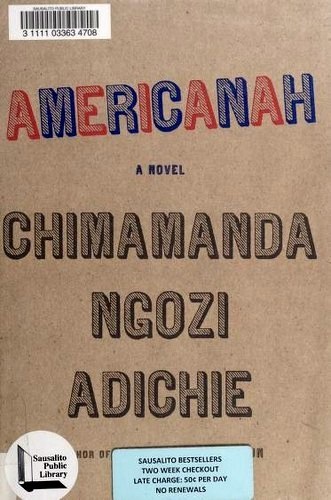
Americanah
Chimamanda Ngozi Adichie (2013)
“A Nigerian woman moves to America and discovers that race is not something you are born with — it is something America assigns to you.”
Essay Questions & Food for Thought
30questions designed to challenge assumptions and provoke original thinking. These can't be answered from a summary — you need the actual text.
Adichie's title refers to Nigerians who return from America affecting American habits. By the end of the novel, is Ifemelu an 'Americanah'? Does she think she is? Does Lagos?
Ifemelu says she 'was not Black' before she came to America. What does this claim mean, philosophically? If race is assigned by America, what does that say about what race IS?
The novel includes blog posts in full — they're not summarized, they're reproduced as actual blog writing. Why does Adichie make this formal choice? What does the blog do that the novel can't?
Ifemelu's encounter with the tennis coach is never shown — only its aftermath. Why does Adichie make this choice? What would be gained and lost by showing it?
Curt is kind and Blaine is principled. Both relationships fail. What does the novel say about the kinds of love that can't work — not because of individual failure but because of structural incompatibility?
Obinze's England chapters and Ifemelu's America chapters are both immigration narratives, but they're different stories. What are the specific differences, and what does each story tell us that the other can't?
The novel ends on a threshold — Obinze arriving at Ifemelu's door. Why does Adichie end here rather than showing what happens next? What would be dishonest about completing the scene?
Aunty Uju tells Dike to suppress his Nigerian-ness and speak 'American English.' Is she wrong? What would the alternative cost?
The blog post about Obama's campaign doesn't name him — Adichie writes around him with obvious but indirect language. Why this choice? What does it preserve?
Ifemelu performs an American accent to get job callbacks. Is this code-switching a survival strategy, a betrayal of self, or both? Can it be both?
Kosi is never a villain, and the novel doesn't present her as one. What is Adichie saying about marriages built on suitability versus marriages built on full self-disclosure?
Ifemelu's blog makes her professionally Black — her outsider's view of American race becomes a marketable commodity. What does it mean when the observation of your own marginalization becomes a career?
Compare how American race and Nigerian class/ethnicity function in the novel. Are they parallel systems? Completely different? What can each reveal about the other?
Hair appears in the opening scene, in blog posts, and in discussions of identity throughout. Why is Black hair such a charged political terrain in this novel specifically?
Blaine demands that Ifemelu show up for the campus protest. Is he asking too much? Is the demand itself a form of the cultural gatekeeping the novel criticizes?
Adichie gives us Obinze's perspective in addition to Ifemelu's. What does his point of view add that Ifemelu's narration couldn't provide? What would be lost if the novel were entirely Ifemelu's story?
The novel is set partially during 9/11's aftermath, which changes who can get a visa and where. How does a historical event that isn't 'about' Nigeria or immigration nonetheless become one of the novel's structural pivots?
Ifemelu returns to Lagos and starts a blog about Nigeria — and it's less successful than her American race blog. What does this tell us about the relationship between outsider status and intellectual authority?
The novel's title — Americanah — is a word used by Nigerians to describe Nigerians who come back from America with affected habits. Is the word a critique, an affectionate tease, or both? How does its meaning change by the end?
How does Adichie use food — specific meals, specific Nigerian dishes — to mark the difference between the Lagos world and the American one?
Is this novel a love story that uses immigration and race as backdrop, or an immigration and race novel that uses love as backdrop? Does the distinction matter?
Adichie has said she was frustrated that American readers often focused on the love story while Nigerian readers focused on the social observation. Why might different readers read the same novel so differently?
Compare Dike's experience to Ifemelu's. Both are Nigerian in America. Why is the second-generation immigrant's experience so different from the first-generation immigrant's?
Ifemelu cheats on Curt without knowing why. Adichie refuses to give her a clean motivation. What is the novel saying about the limits of self-knowledge — and about what infidelity can mean when it has no clear explanation?
Adichie is Nigerian writing about America; she is not writing from inside African-American experience. Some critics see this as the novel's great strength; others see it as a limitation. Engage both sides.
The novel ends in 2013. How would Ifemelu's story be different if she were immigrating in 2026 — with social media, smartphones, and a different political climate? Would the blog still work?
Obinze is deported just before his sham wedding. What is the specific humiliation of deportation — and how does Adichie render it without melodrama?
How does the novel treat class — within Nigeria, within America, and between the two countries? Is class more or less visible than race in the novel?
'She had not thought of herself as Black before she came to America.' This claim appears early and is never retracted. Is it fully true? Was there no racial self-awareness at all in Nigeria?
Read the final paragraph of the novel. Adichie ends on a door being opened and a 'rush of feeling' — not on resolution. Why is this the correct ending? What would be wrong with showing what happens next?