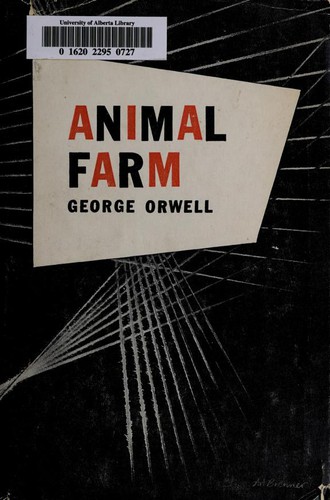
Animal Farm
George Orwell (1945)
“A fairy tale for adults: seven commandments, one pig, and the most efficient political horror story ever written at 112 pages.”
This page prints on a single page. Use Ctrl+P / Cmd+P.
Animal Farm
George Orwell (1945) · 112pages · Modernist / Political Allegory · 9 AP appearances
Summary
The animals of Manor Farm revolt against their drunken farmer Mr. Jones, inspired by the dying boar Old Major's vision of Animalism — a society where all animals are equal. The pigs, led by Napoleon and Snowball, take charge after the rebellion succeeds. Napoleon exiles Snowball, rewrites history, and slowly transforms the new Animal Farm back into something indistinguishable from the tyranny it replaced. The final image: the pigs walk on two legs, carry whips, and the other animals looking through the window from outside cannot tell pig from man.
Why It Matters
Published in 1945, Animal Farm became one of the first widely read English-language critiques of Soviet totalitarianism — at a moment when the Western left was still largely defending Stalin. It influenced Cold War ideology, cemented Orwell's reputation, and remains one of the most translated boo...
Themes & Motifs
Diction & Style
Register: Deliberately plain — Anglo-Saxon vocabulary, short sentences, concrete nouns. Orwell writes as though for a child, which is exactly how political horror works: clear, simple, unavoidable.
Narrator: Anonymous, close-third, fable-dry. The narrator never editorializes, never signals horror, never tells us what to fee...
Figurative Language: Low by design. Orwell's figurative language appears only where it is doing specific work
Historical Context
WWII era — written 1943-44, published August 1945, just as WWII ended: Every major plot event maps onto a specific historical event, specific enough that Orwell's contemporaries recognized the allegory immediately. But the allegory transcends its historical moment — t...
Key Characters
Talking Points
- Orwell chose to write Animal Farm as a fable — fairy-tale language, animal characters, a simple moral structure. Why? What does the fable form allow him to say about Stalin's Soviet Union that a realistic political novel could not?
- Orwell makes Boxer's death the emotional climax of a political satire. Why does a novel about ideology need to break your heart over a horse? What does Boxer accomplish that abstract argument cannot?
- The pigs never say 'we are taking this for ourselves.' They always say 'we are doing this to prevent Jones from returning.' Why is this specific rhetorical move so effective — and so recognizable?
- Old Major's speech in Chapter 1 is genuinely persuasive. Orwell doesn't undercut it. Why does the novel take Old Major's vision seriously rather than presenting it as naive from the start?
- Squealer uses statistics, scientific claims, and appeals to expertise to justify the pigs' privileges. Why is this more effective — and more sinister — than simple lying?
Notable Quotes
“Man is the only creature that consumes without producing. He does not give milk, he does not lay eggs, he is too weak to pull the plough, he cannot...”
“Whatever goes upon two legs is an enemy. Whatever goes upon four legs, or has wings, is a friend.”
“Beasts of England, Beasts of Ireland, Beasts of every land and clime, Hearken to my joyful tidings of the golden future time.”
Why Read This
Because it is 112 pages that contain more political insight than most 600-page history books. Because every generation encounters a new situation where the Commandments are being rewritten and Squealer is explaining why that's actually fine. Becau...