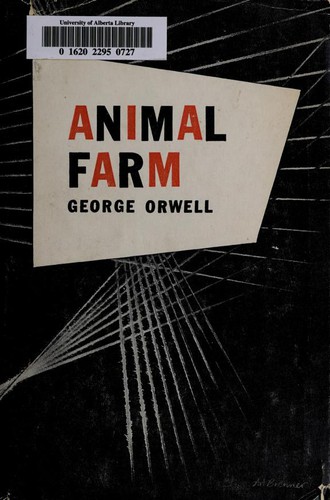
Animal Farm
George Orwell (1945)
“A fairy tale for adults: seven commandments, one pig, and the most efficient political horror story ever written at 112 pages.”
Animal Farm— Summary & Analysis
by George Orwell · published 1945 · 112 pages · Modernist / Political Allegory
A user-friendly study guide for Animal Farm by George Orwell (1945): a high-level plot summary, full chapter-by-chapter analysis, theme breakdowns, character profiles, and 30 essay questions designed for middle-school, high-school, ap-english readers. Unlike a stock summary, sumsumsum.com adds a diction analysis drawn from George Orwell’s actual text, the 9 documented AP Literature exam appearances of this book, and reading-difficulty guidance (Easy, 2/10) so students, teachers, and lifelong readers know what they are walking into.
“A fairy tale for adults: seven commandments, one pig, and the most efficient political horror story ever written at 112 pages.”
Short Summary
The animals of Manor Farm revolt against their drunken farmer Mr. Jones, inspired by the dying boar Old Major's vision of Animalism — a society where all animals are equal. The pigs, led by Napoleon and Snowball, take charge after the rebellion succeeds. Napoleon exiles Snowball, rewrites history, and slowly transforms the new Animal Farm back into something indistinguishable from the tyranny it replaced. The final image: the pigs walk on two legs, carry whips, and the other animals looking through the window from outside cannot tell pig from man.
Detailed Summary
Old Major, the prize boar of Manor Farm, gathers the animals one night to share a dream: a world where animals throw off the tyranny of humans and live free. His vision of Animalism — complete animal equality, no masters, no exploitation — dies with him three nights later. But the seed is planted. ...
Summary in the Author’s Writing Style
A retelling of Animal Farm in George Orwell’s style — so you can hear the language, not just the plot. This is a stylistic pastiche written by sumsumsum, not an excerpt from the book.
Old Major, the prize boar, called the animals together one night and told them his dream. He said that man was the only creature that consumed without producing, and that the day would come when the animals would throw him off and live free. Three nights later he died. But the animals remembered, an…
Chapter-by-Chapter Analysis
If you liked Animal Farm, read next
Start with Brave New World by Aldous Huxley — The other great twentieth-century dystopia — where Orwell fears we will be oppressed, Huxley fears we will be entertained into submission. Both anxieties turned out to be correct.. Then try Lord of the Flies by William Golding — Same premise: remove the restraints of civilization and observe what emerges. Golding's boys and Orwell's pigs reach similar conclusions by different routes.. Or pivot to Gulliver's Travels by Jonathan Swift — The great ancestor — political satire through fantastical displacement. Orwell credited Swift as his model: use impossible situations to make possible truths unavoidable..
For comparative essays, pair Animal Farm with
The strongest comparative pairing is The Handmaid's Tale (Margaret Atwood) — Atwood extends Orwell's technique to gender — a theocratic totalitarianism that uses the same commandment-revision and propaganda-smoothing mechanisms, now targeting women specifically.
Each of these pairings opens a clean thesis path on shared themes, period diction, or formal influence — useful for AP Lit / IB / first-year college comparative essays.
More from George Orwell and the scholars who study Orwell
Other works by George Orwell: 1984 (1949, 328 pages). Reading two or three of these in sequence reveals George Orwell’s recurring obsessions and stylistic signatures more clearly than any single book can.
The standard scholarly entry points to George Orwell’s work: Bernard Crick (Birkbeck, first authorized biographer) — George Orwell: A Life (1980); D. J. Taylor (British biographer, Whitbread winner) — Orwell: The Life (2003). These are the works graduate seminars cite when teaching George Orwell.