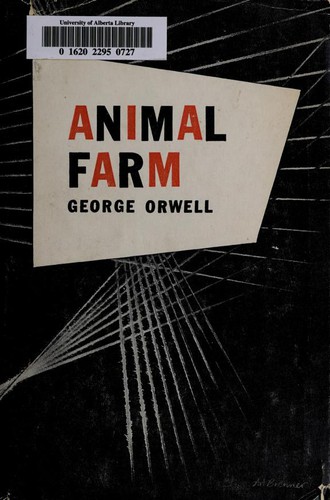
Animal Farm
George Orwell (1945)
“A fairy tale for adults: seven commandments, one pig, and the most efficient political horror story ever written at 112 pages.”
Why This Book Matters
Published in 1945, Animal Farm became one of the first widely read English-language critiques of Soviet totalitarianism — at a moment when the Western left was still largely defending Stalin. It influenced Cold War ideology, cemented Orwell's reputation, and remains one of the most translated books in the world. In 2017, it was reported to be one of the top ten most shoplifted books from American bookstores — which is possibly the most Orwellian data point about the novel's cultural penetration.
Firsts & Innovations
First major political allegory in English to directly indict Soviet communism at a moment when it was unfashionable and professionally dangerous to do so
Pioneered the use of the animal fable form for adult contemporary political satire — distinguishing it from children's fables by treating adult power with children's language
One of the first works to coin a phrase that entered political vocabulary globally: 'All animals are equal, but some are more equal than others' is quoted in political science, law, philosophy, and journalism worldwide
Cultural Impact
The phrase 'some animals are more equal than others' has entered political language worldwide as shorthand for official hypocrisy
Translated into more than 70 languages — often read in countries experiencing the conditions it describes
Banned or restricted in Soviet Union, China, Cuba, North Korea, and other states — proving its thesis about what those in power do with inconvenient texts
Required reading in most English-speaking school systems; assigned in middle school, high school, and university across curricula
Napoleon, Snowball, Squealer, and Boxer have entered the language as character archetypes beyond the novel's context
Banned & Challenged
Banned by the Soviet Union and suppressed across the Eastern Bloc throughout the Cold War. Rejected by British publishers during WWII for political reasons — a form of pre-publication censorship that proved the novel's thesis before it was published. Banned in Cuba and China. Challenged in American schools for being 'Communist propaganda' (a spectacular misreading), for its violence, and for being 'too political.' A 1954 CIA-funded animated film adaptation was made as propaganda — and the ending was changed to remove the pigs-and-men final ambiguity, because the ambiguity (suggesting all powerful states become equal in their tyranny) was too uncomfortable for the CIA's purposes.