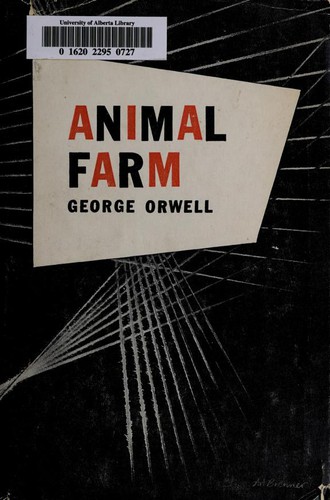
Animal Farm
George Orwell (1945)
“A fairy tale for adults: seven commandments, one pig, and the most efficient political horror story ever written at 112 pages.”
Animal Farm— Historical Context & Author Background
Author: George Orwell · Published 1945· Era: Modernist / Political Allegory·112 pages
Themes explored: power, corruption, propaganda, revolution, class, equality, totalitarianism, language
About George Orwell
Eric Arthur Blair (1903-1950), writing as George Orwell, was a man who had seen idealism fail from the inside. He went to Burma as an Imperial Police officer and hated what imperialism did to both the colonized and the colonizer. He lived among the poor in Paris and London, shoveling their reality into The Road to Wigan Pier. He went to Spain in 1936 to fight fascism with the POUM militia — and was shot through the throat by a fascist sniper, survived, then had to flee Barcelona with his wife when the Soviet-backed communist factions turned on the POUM, arresting, torturing, and killing Orwell's comrades. He came home knowing that Soviet communism was not the revolution's fulfillment but its betrayal. Animal Farm was written in 1943-44, rejected by four major publishers — including T.S. Eliot at Faber & Faber — because the Soviet Union was Britain's wartime ally and criticizing Stalin was politically unacceptable. Published at last in 1945 by a small press, it made Orwell famous and remains the most widely translated work of political fiction in the world.
Life → Text Connections
How George Orwell's real experiences shaped specific elements of Animal Farm.
Orwell fought with the POUM militia in the Spanish Civil War and witnessed Soviet-backed communists suppress, arrest, and murder fellow anti-fascists
Napoleon's show trials and purges — animals confess to collaboration with Snowball and are killed — directly mirror the Moscow Trials and the Soviet suppression of rival leftist factions in Spain
Orwell wasn't writing from books. He'd seen Stalinist terror first-hand, had been targeted by it, and came home with a specific, embodied understanding of how revolution becomes tyranny from inside.
Animal Farm was rejected by Victor Gollancz, Jonathan Cape, and T.S. Eliot at Faber, explicitly because of the Soviet alliance — Eliot's rejection letter called it 'Trotskyite' and said the pigs should be more sympathetic
The book's central argument — that power corrupts even idealistic revolutionaries — was rejected as politically inconvenient, not artistically defective
The suppression of Animal Farm is itself proof of the novel's thesis: those with power over publication, like those with power over farms, decide what truths can be told.
Orwell saw how the British left's uncritical devotion to the Soviet Union prevented honest reporting on Stalin's crimes throughout the 1930s and early 1940s
The animals who cannot quite remember the original commandments, who accept Squealer's revisions because they want to believe — these are the British intellectuals who knew but looked away
Animal Farm is as much about Western self-deception as Soviet tyranny. The animals' willingness to be deceived is not stupidity — it is wishful thinking, which Orwell found more culpable.
Orwell's own politics were socialist — he believed in working-class liberation and hated capitalism's inequalities — which makes Animal Farm a work of heartbreak, not conservative critique
Old Major's vision is genuinely presented as beautiful. The rebellion is genuinely just. Orwell mourns what happened to the revolution; he does not argue that the revolution should never have happened.
Animal Farm is often read as anti-socialist. Orwell considered it pro-socialist — a warning about what happens to socialism when power is not democratically distributed. The distinction is crucial.
Historical Era
WWII era — written 1943-44, published August 1945, just as WWII ended
How the Era Shapes the Book
Every major plot event maps onto a specific historical event, specific enough that Orwell's contemporaries recognized the allegory immediately. But the allegory transcends its historical moment — the novel has been read as a critique of every authoritarian regime since its publication, because the mechanism it describes (revolutionary ideals corrupted by power, history rewritten to protect the powerful, language weaponized against truth) is not uniquely Soviet. It is structural.
Why Animal Farm Matters Historically
Published in 1945, Animal Farm became one of the first widely read English-language critiques of Soviet totalitarianism — at a moment when the Western left was still largely defending Stalin. It influenced Cold War ideology, cemented Orwell's reputation, and remains one of the most translated books in the world. In 2017, it was reported to be one of the top ten most shoplifted books from American bookstores — which is possibly the most Orwellian data point about the novel's cultural penetration.
- First major political allegory in English to directly indict Soviet communism at a moment when it was unfashionable and professionally dangerous to do so
- Pioneered the use of the animal fable form for adult contemporary political satire — distinguishing it from children's fables by treating adult power with children's language
- One of the first works to coin a phrase that entered political vocabulary globally: 'All animals are equal, but some are more equal than others' is quoted in political science, law, philosophy, and journalism worldwide
Banned by the Soviet Union and suppressed across the Eastern Bloc throughout the Cold War. Rejected by British publishers during WWII for political reasons — a form of pre-publication censorship that proved the novel's thesis before it was published. Banned in Cuba and China. Challenged in American schools for being 'Communist propaganda' (a spectacular misreading), for its violence, and for being 'too political.' A 1954 CIA-funded animated film adaptation was made as propaganda — and the ending was changed to remove the pigs-and-men final ambiguity, because the ambiguity (suggesting all powerful states become equal in their tyranny) was too uncomfortable for the CIA's purposes.