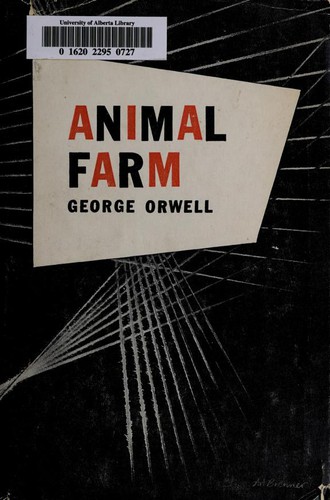
Animal Farm
George Orwell (1945)
“A fairy tale for adults: seven commandments, one pig, and the most efficient political horror story ever written at 112 pages.”
Essay Questions & Food for Thought
30questions designed to challenge assumptions and provoke original thinking. These can't be answered from a summary — you need the actual text.
Orwell chose to write Animal Farm as a fable — fairy-tale language, animal characters, a simple moral structure. Why? What does the fable form allow him to say about Stalin's Soviet Union that a realistic political novel could not?
Orwell makes Boxer's death the emotional climax of a political satire. Why does a novel about ideology need to break your heart over a horse? What does Boxer accomplish that abstract argument cannot?
The pigs never say 'we are taking this for ourselves.' They always say 'we are doing this to prevent Jones from returning.' Why is this specific rhetorical move so effective — and so recognizable?
Old Major's speech in Chapter 1 is genuinely persuasive. Orwell doesn't undercut it. Why does the novel take Old Major's vision seriously rather than presenting it as naive from the start?
Squealer uses statistics, scientific claims, and appeals to expertise to justify the pigs' privileges. Why is this more effective — and more sinister — than simple lying?
Animal Farm was written during the height of the Soviet-British wartime alliance and rejected by multiple publishers because of it. How does knowing the book was suppressed change your reading of its argument about who controls narrative?
The Moscow Show Trials (1936-38) featured impossible confessions from people who clearly had not done what they confessed to. How does Orwell represent this in Chapter 7, and what does he suggest about how such confessions happen?
The Molotov-Ribbentrop Pact — Stalin's non-aggression deal with Hitler, 1939 — is directly represented in Napoleon's timber deal with Frederick. What does Orwell suggest about ideological flexibility when power is at stake?
A 1954 CIA-funded animated film adaptation changed Animal Farm's ending — removing the final scene where pigs and men are indistinguishable. Why would the CIA want to remove that ending? What does it reveal about who the novel's real targets are?
Animal Farm has been read as anti-communist propaganda, as a socialist warning about the corruption of socialist ideals, and as a universal statement about power. Which reading does the text best support, and which does Orwell's biography support?
Moses the raven preaches Sugarcandy Mountain — a heaven for animals. The pigs initially suppress him; later they allow him back and give him beer. What does Moses represent, and why does Napoleon find him useful once in power?
Benjamin never acts. He sees everything, says almost nothing, and reads the van's side too late. Is Benjamin Orwell's criticism of the intellectual class — or is he a tragic figure who understands his own powerlessness?
The hens' rebellion in Chapter 7 is the only internal rebellion after Napoleon's takeover. It lasts five days, kills three hens, and accomplishes nothing. What does Orwell suggest about why resistance fails under totalitarian regimes?
Most of the animals who remember the original Seven Commandments cannot read. They know something has changed but cannot prove it. Why does Orwell make literacy — or its absence — central to the mechanism of oppression?
Mollie the mare leaves Animal Farm for a human who will give her sugar and hair ribbons. Orwell presents her departure as a small betrayal. Is she wrong? Does her choice reveal a limitation in Old Major's vision?
Social media companies algorithmically amplify outrage, remove posts that violate terms of service, and ban accounts. In what ways is this analogous to Squealer amending the Commandments? Where does the analogy break down?
In 2023 and 2024, several governments prosecuted journalists, activists, and political opponents under national security laws while framing the prosecutions as protecting democracy. How does Squealer's language apply to contemporary political speech?
The revision of Snowball's role at the Battle of the Cowshed — from hero to traitor — is a form of historical revisionism. Give a real-world example (from any era, any country) of a similar historical rewrite and analyze the mechanism.
Boxer's motto 'Napoleon is always right' makes him the perfect worker and the perfect victim. How does this dynamic appear in contemporary workplace culture — in slogans like 'the customer is always right,' 'trust the process,' or corporate loyalty narratives?
Animal Farm ends with the animals unable to tell pigs from men. In a world where corporations increasingly resemble governments and governments increasingly operate like corporations — has the final image become even more accurate?
The Seven Commandments are changed by adding words ('without sheets,' 'to excess,' 'without cause'). How does this amendment technique differ from outright lying, and why is it more effective?
Orwell uses the Sunday Meeting as a structural device — its abolition in Chapter 5 marks the end of democracy, and its replacement by pig decree marks the beginning of autocracy. Why does collective deliberation terrify autocrats?
The novella ends where it begins — Manor Farm, a farm controlled by oppressors, animals watching through a window. How does this circular structure reinforce the novel's political argument?
Orwell places 'Beasts of England' — the revolutionary anthem — at the very beginning and bans it at the midpoint. What is the structural function of the song's arc in the novella?
The novella has ten chapters but only one narrative arc. Is there a moment — a specific chapter or scene — where the outcome becomes inevitable? Where the revolution is already lost even if no one knows it yet?
Compare Animal Farm's Napoleon to Macbeth. Both come to power through a mixture of ambition and violence, both rely on propaganda, both cannot stop once they begin. Which is the more effective portrait of political evil, and why?
Compare Squealer to Iago in Othello. Both manipulate through language, both serve a powerful figure while being the real engine of destruction. What makes Squealer's version of manipulation distinctly modern and political rather than personal?
Orwell wrote Nineteen Eighty-Four four years after Animal Farm. In what ways is Animal Farm the lighter version of the same argument? What does Nineteen Eighty-Four add that Animal Farm deliberately omits?
Compare Boxer to Lennie in Of Mice and Men. Both are physically powerful, intellectually trusting, deeply loyal, and destroyed by the systems that use them. What does each author achieve by giving enormous physical strength to a character who is exploited rather than protected by it?
Animal Farm is sometimes described as a children's book written for adults. Swift's Gulliver's Travels was described similarly. What does the children's form — simple language, animal characters, clear moral — allow a political satirist to do that realistic adult fiction cannot?