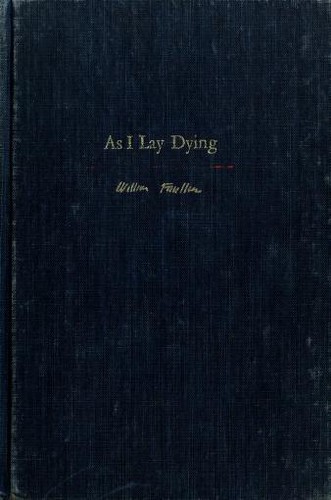
As I Lay Dying— Historical Context & Author Background
Author: William Faulkner · Published 1930· Era: Modernist / Southern Gothic·267 pages
Themes explored: death, family, duty, identity, isolation, absurdity, grief
About William Faulkner
William Cuthbert Faulkner (1897-1962) was born in New Albany, Mississippi, and raised in Oxford — the seat of Lafayette County, which he reimagined as Yoknapatawpha County in his fiction. He dropped out of the University of Mississippi, worked odd jobs, briefly served in the Canadian Royal Air Force (WWI ended before he saw combat), and returned to Oxford. He spent much of his career in financial difficulty, writing for Hollywood to pay bills. As I Lay Dying was written in six weeks during night shifts at a power plant, on an upturned wheelbarrow, in 1929. He described the process: 'I set out deliberately to write a tour-de-force. I had made up the story and did not know it would be difficult until I began to write it.' He won the Nobel Prize in 1949, largely on the strength of European rediscovery of his work.
Life → Text Connections
How William Faulkner's real experiences shaped specific elements of As I Lay Dying.
Faulkner grew up in the Mississippi hill country among poor farm families; his great-grandfather was a Civil War colonel, but the family had fallen from its antebellum prominence
The Bundrens' poverty and pride — they are not without dignity, but they have nothing. The Southern class system in miniature.
Faulkner understood the particular combination of pride and deprivation that characterized poor white Mississippi. The Bundrens are not caricatures — they are people he grew up around.
Faulkner wrote the novel in six weeks during night-shift work at a power plant — the most compressed creative period of any major American novel
The novel's formal ambition — 15 narrators, 59 chapters — achieved without sprawl. The compression of the writing is in the compression of the form.
The novel's intensity is partly the intensity of a writer working at full capacity under pressure. The power plant story is also a story about working-class creative life — genius operating in the margins.
Faulkner's Yoknapatawpha County is a fictional version of Lafayette County, Mississippi — the same geography, history, and social structure reimagined
The specificity of the landscape — the roads, the river crossing, the valley, the town — reflects a writer who knew this land in his body
The physical journey in the novel is geographically real — based on actual roads Faulkner knew. The flood and the terrain are the terrain of his childhood.
Historical Era
Rural Mississippi, late 1920s — post-Reconstruction South, Great Depression threshold
How the Era Shapes the Book
The Bundrens' poverty is not metaphorical — it is the poverty of actual Mississippi farm families in the years just before the Depression ground them further. The family cannot afford the doctor who could properly set Cash's leg. The money Anse extracts from his children is the only money any of them have. The asylum at Jackson — to which Darl is sent — was Mississippi's actual institution for the mentally ill, used as Faulkner depicts it. The journey is absurd partly because poverty makes it expensive in ways Anse cannot account for and refuses to acknowledge.
Why As I Lay Dying Matters Historically
Published in 1930 to modest critical attention; now considered one of the formal masterpieces of world literature. The multi-narrator technique — 15 voices in 59 chapters with no authoritative external narrator — was unprecedented in American fiction and remains one of the most ambitious formal experiments in the novel form. Faulkner won the Nobel Prize in 1949 (with his wider body of work). The novel demonstrated that modernist stream-of-consciousness technique was not the exclusive property of European urban consciousness — that it could be applied to rural, working-class, Southern American experience with equal or greater force.
- First major American novel with a rotating narrator structure of this scale — 15 narrators, 59 chapters
- First sustained application of Joycean stream-of-consciousness to Southern working-class rural experience
- One of the first American novels to present a corpse as the organizing principle of a narrative journey
- Vardaman's 'My mother is a fish' became a landmark example in minimalist chapter technique and stream-of-consciousness pedagogy
Challenged for profanity, sexual content (Dewey Dell's pregnancy and the MacGowan assault), and nihilism. Occasionally challenged for its blackly comic treatment of the Whitfield character as an affront to Christian values. Its relative obscurity compared to Gatsby or Mice and Men protected it from concerted challenges.