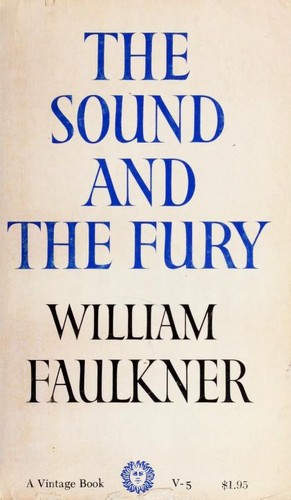
The Sound and the Fury
William Faulkner (1929)
“Four voices. Four narrators. One family destroying itself in real time — and Faulkner gives the first chapter to the one who cannot understand what he's telling you.”
The Sound and the Fury— Historical Context & Author Background
Author: William Faulkner · Published 1929· Era: American Modernism / Southern Gothic·326 pages
Themes explored: time, decay, race, family, loss, madness, honor
About William Faulkner
William Cuthbert Faulkner (1897-1962) was born in New Albany, Mississippi and grew up in Oxford, the fictional template for Jefferson. He was a high school dropout who joined the Royal Canadian Air Force in 1918 (the war ended before he saw combat, but he invented combat experience afterward). He lived in the declining world of post-Civil War Southern aristocracy, watching old families lose their land and their sons to a code of honor that no longer corresponded to reality. He was paid almost nothing for The Sound and the Fury; it sold poorly; he wrote Hollywood scripts to survive. He won the Nobel Prize in 1949 and gave one of the most celebrated acceptance speeches in the Prize's history. He died of a heart attack in 1962, three years after A Fable won the Pulitzer.
Life → Text Connections
How William Faulkner's real experiences shaped specific elements of The Sound and the Fury.
Faulkner grew up in Oxford, Mississippi watching old aristocratic families liquidate their land and their dignity
The Compsons sell their pasture, their honor, and finally their sanity — the family's material decline mirrors its spiritual one
The decay is not metaphor — Faulkner watched it happen to real families, including his own
Faulkner struggled with alcoholism his entire adult life
Jason Compson III's alcoholic philosophy, the father who could diagnose his son's suffering but couldn't interrupt his own
The father's nihilism — 'you will forget this' — is the voice of a man who has learned to forget through drinking
Faulkner wrote the novel in a burst, convinced no publisher would take it — he said he wrote it 'for myself and God' and didn't expect it to be published
The experimental structure — four radically different sections — that commercial sense would have smoothed out
The novel's formal radicalism was enabled by Faulkner's conviction that it wouldn't succeed. The freedom of the doomed manuscript.
Faulkner grew up in the Jim Crow South and spent his life navigating his complex feelings about race and the Confederate legacy
Jason's casual racism, the Confederate monument at the end, Dilsey's complex position as moral center and domestic servant
Faulkner is not outside the racial system he depicts — he is implicated in it, and the novel's treatment of Dilsey reflects both his insight and his limitations
Historical Era
Post-Civil War American South — Reconstruction's aftermath, Jim Crow, the end of the plantation aristocracy
How the Era Shapes the Book
The Compson family's collapse is inseparable from the South's. The land sold to pay for Quentin's Harvard education was pasture that had once been plantation. The Black servants who sustain the household are products of a racial labor system that the Civil War ended legally but not practically. Jason's bitterness is partly the bitterness of a class that lost its economic basis and never recovered. Dilsey's endurance is the endurance of a community that had been surviving impossible conditions for generations. The Confederate monument in the final scene is not incidental — it is the material embodiment of the story the South tells itself about its own past.
Why The Sound and the Fury Matters Historically
The Sound and the Fury is the novel Faulkner himself called his best — his most ambitious, his most agonized, and his least commercial. It was passed over by readers for years, understood only by a small audience, and then rescued by academic criticism in the 1940s and 50s. It is now recognized as one of the two or three most formally innovative novels in American literature — the experiment that proved stream of consciousness could work in American prose as it had for Joyce in Irish prose.
- First major American novel to use multiple unreliable narrators telling the same story from irreconcilable perspectives
- First sustained American deployment of stream-of-consciousness narration as structural architecture rather than local technique
- First novel to use an intellectually disabled narrator (Benjy) as primary consciousness — and to make that choice thematically essential rather than exploitative
Challenged in school curricula for racial slurs (the word appears throughout, especially in Jason's section), for sexual content (Caddy's promiscuity and pregnancy, Quentin's incest fantasy), and for general difficulty — some school boards have objected not to the content but to the form, arguing that a deliberately confusing novel has no educational value. The latter objection rather proves the point.