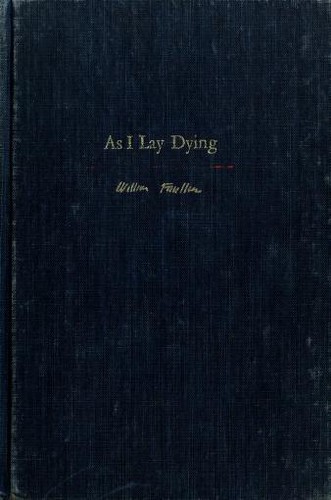
As I Lay Dying— Summary & Analysis
by William Faulkner · published 1930 · 267 pages · Modernist / Southern Gothic
A user-friendly study guide for As I Lay Dying by William Faulkner (1930): a high-level plot summary, full chapter-by-chapter analysis, theme breakdowns, character profiles, and 30 essay questions designed for ap-english, college readers. Unlike a stock summary, sumsumsum.com adds a diction analysis drawn from William Faulkner’s actual text, the 9 documented AP Literature exam appearances of this book, and reading-difficulty guidance (Moderate, 4/10) so students, teachers, and lifelong readers know what they are walking into.
“Fifteen voices. One corpse. A nine-day journey through flood and fire to bury a woman her family may not have loved.”
Short Summary
Addie Bundren dies on a Mississippi farm. Her husband Anse, despite being broke and feckless, promised to bury her in Jefferson — forty miles away. Her five children have conflicting, often selfish reasons for making the journey. Over nine days the family hauls Addie's rotting coffin through flood, fire, and social catastrophe. Each chapter is narrated by a different character — fifteen voices in all. The coffin arrives. Addie is buried. Anse promptly gets new teeth and a new wife. The family is destroyed.
Detailed Summary
Addie Bundren lies dying in her Mississippi farmhouse while her son Cash builds her coffin outside her window, measuring each plank with methodical care. Her husband Anse sits helplessly on the porch. Daughter Dewey Dell is seventeen and pregnant by a neighbor boy, desperate to reach Jefferson for a...
Summary in the Author’s Writing Style
A retelling of As I Lay Dying in William Faulkner’s style — so you can hear the language, not just the plot. This is a stylistic pastiche written by sumsumsum, not an excerpt from the book.
She lies behind the window where the lamp makes a small yellow place against the coming dark, and Cash is out there in the dooryard fitting the planks one to another, each one measured and beveled and laid true, because Cash believes a thing made on the bevel will hold and that holding is the only w…
Chapter-by-Chapter Analysis
If you liked As I Lay Dying, read next
Start with The Road by Cormac McCarthy — Same stripped, uncompromising register in its plainest passages — a journey that is also an endurance test, stripped of consolation, refusing catharsis.
For comparative essays, pair As I Lay Dying with
The strongest comparative pairing is Beloved (Toni Morrison) — Another novel organized around a dead body whose presence transforms the living — grief as haunting, motherhood taken to its most extreme form. Another productive pairing is One Flew Over the Cuckoo's Nest (Ken Kesey) — Another novel about institutionalizing the perceptive — Darl's commitment echoes McMurphy's, clarity punished by a system that needs everyone manageable. For a third angle, contrast with Death of a Salesman (Arthur Miller) — Same dissection of family duty and self-deception — Willy Loman and Anse Bundren are both men who take from their families while telling themselves they are providing.
Each of these pairings opens a clean thesis path on shared themes, period diction, or formal influence — useful for AP Lit / IB / first-year college comparative essays.
More from William Faulkner and the scholars who study Faulkner
Other works by William Faulkner: Light in August (1932, 507 pages), The Sound and the Fury (1929, 326 pages). Reading two or three of these in sequence reveals William Faulkner’s recurring obsessions and stylistic signatures more clearly than any single book can.
The standard scholarly entry points to William Faulkner’s work: Joseph Blotner (University of Michigan, authorized biographer) — Faulkner: A Biography (1974); John T. Matthews (Boston University, deconstructionist Faulknerian) — The Play of Faulkner's Language (1982). These are the works graduate seminars cite when teaching William Faulkner.