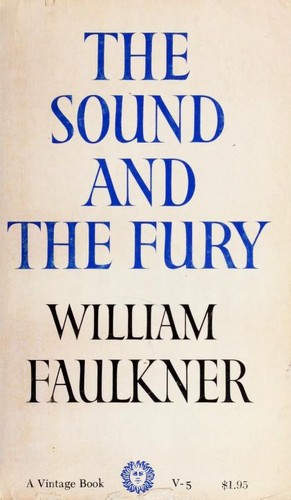
The Sound and the Fury
William Faulkner (1929)
“Four voices. Four narrators. One family destroying itself in real time — and Faulkner gives the first chapter to the one who cannot understand what he's telling you.”
The Sound and the Fury— Summary & Analysis
by William Faulkner · published 1929 · 326 pages · American Modernism / Southern Gothic
A user-friendly study guide for The Sound and the Fury by William Faulkner (1929): a high-level plot summary, full chapter-by-chapter analysis, theme breakdowns, character profiles, and 30 essay questions designed for ap-english, college readers. Unlike a stock summary, sumsumsum.com adds a diction analysis drawn from William Faulkner’s actual text, the 18 documented AP Literature exam appearances of this book, and reading-difficulty guidance (Moderate, 5/10) so students, teachers, and lifelong readers know what they are walking into.
“Four voices. Four narrators. One family destroying itself in real time — and Faulkner gives the first chapter to the one who cannot understand what he's telling you.”
Short Summary
The Compson family of Jefferson, Mississippi collapses over three days in April 1928, told through four radically different narrators: Benjy (intellectually disabled, no sense of time), Quentin (suicidal Harvard student in 1910), Jason (bitter, mercenary, the functional 'normal' brother), and Dilsey (the Black servant who holds what's left together). The novel's subject is the decay of the Old South through one aristocratic family — their loss of land, money, honor, and sanity — and the gap between how each mind constructs the same catastrophe.
Detailed Summary
The Sound and the Fury tells one story four times, each version more legible than the last, and each more devastating. The Compson family — once land-owning Mississippi aristocracy — is in terminal decline. The father, Jason Compson III, is an alcoholic philosopher. The mother, Caroline, is a hypoch...
Summary in the Author’s Writing Style
A retelling of The Sound and the Fury in William Faulkner’s style — so you can hear the language, not just the plot. This is a stylistic pastiche written by sumsumsum, not an excerpt from the book.
Through the fence, between the curling flower spaces, I could see them hitting. They were coming toward where the flag was and I went along the fence. Luster was hunting in the grass by the flower tree. They took the flag out and they were hitting. Then they put the flag back and they went to the ta…
Chapter-by-Chapter Analysis
If you liked The Sound and the Fury, read next
Start with Ulysses by James Joyce — The direct predecessor — Faulkner absorbed Joyce's stream-of-consciousness innovations and pushed them further into the American vernacular. Then try Beloved by Toni Morrison — Morrison's formal debt to Faulkner is explicit — shattered chronology, multiple perspectives, the past as permanent present, trauma that cannot be processed linearly. Or pivot to The Great Gatsby by F. Scott Fitzgerald — Published four years earlier — same modernist moment, opposite formal approach. Where Fitzgerald controls his beauty, Faulkner lets his narrative collapse under the weight of what it contains..
More from William Faulkner and the scholars who study Faulkner
Other works by William Faulkner: As I Lay Dying (1930, 267 pages), Light in August (1932, 507 pages). Reading two or three of these in sequence reveals William Faulkner’s recurring obsessions and stylistic signatures more clearly than any single book can.
The standard scholarly entry points to William Faulkner’s work: Joseph Blotner (University of Michigan, authorized biographer) — Faulkner: A Biography (1974); John T. Matthews (Boston University, deconstructionist Faulknerian) — The Play of Faulkner's Language (1982). These are the works graduate seminars cite when teaching William Faulkner.