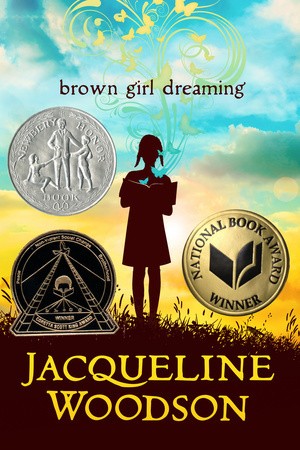
Brown Girl Dreaming
Jacqueline Woodson (2014)
“A childhood lived across the civil rights era, told in poems so precise they feel like memory itself — and a love letter to the power of words when the world refuses to hear you.”
This page prints on a single page. Use Ctrl+P / Cmd+P.
Brown Girl Dreaming
Jacqueline Woodson (2014) · 337pages · Contemporary · 2 AP appearances
Summary
Jacqueline Woodson's memoir in verse traces her childhood from her birth in Ohio in 1963, through her early years in Greenville, South Carolina, raised by her mother's deeply religious family as the civil rights movement erupts around her, to her move to Brooklyn, New York, where she begins to find her voice as a writer. Told in spare, luminous free verse, the book is a portrait of a child caught between two worlds, two cities, two grandparents, and a country in the slow, painful act of changing.
Why It Matters
Brown Girl Dreaming won the 2014 National Book Award for Young People's Literature and multiple Newbery Honor citations. It is one of the most decorated books in contemporary children's and young adult literature, and one of the first verse memoirs to reach a mainstream youth audience at the leve...
Themes & Motifs
Diction & Style
Register: Conversational in diction but highly crafted in form — everyday words arranged with the precision of poetry
Narrator: Jacqueline as child: observational, non-judgmental, precise in sensation, limited in interpretation. Woodson never vi...
Figurative Language: Moderate
Historical Context
1963-1970s, American civil rights era and its aftermath, the Great Migration, desegregation of Southern cities: The civil rights era is not background decoration — it is the water the family swims in. The legal changes happening around Jacqueline's childhood are real changes, but they are experienced from be...
Key Characters
Talking Points
- Why does Woodson choose to write her memoir in free verse rather than prose? What can a poem do that a paragraph of prose cannot, and what does this choice cost the reader?
- Jacqueline cannot read well as a child, yet she becomes one of the most celebrated writers of her generation. What does this paradox tell us about the relationship between reading and writing — or between literacy and intelligence?
- Woodson uses the same title for two different sections of the book: 'Followed by the Moon.' Why? What has changed about the moon's meaning between the first use and the second?
- The civil rights movement appears at the edges of Jacqueline's childhood rather than at its center. Why might Woodson have made this choice? What would be lost if the movement were more explicitly present?
- Woodson presents the grandmother's strict Jehovah's Witness faith without judging it — as a genuine survival strategy rather than an error. Do you agree with her portrayal? What does the faith give the family, and what does it cost them?
Notable Quotes
“I am born as the South explodes, / Rosa Parks taking a seat, / nine kids walking into a school.”
“February 12, 1963 / I am born on the day / Lincoln is said to have been born.”
“My grandmother is from Greenville / and her mother was from Greenville / and the Greenville they know / is the one that doesn't yet know / it's in ...”
Why Read This
Because here is a book that proves the child who cannot read the way other children read is not broken — and because the form shows you that poetry is not something separate from life, but the most accurate way to record it. Every poem is short en...