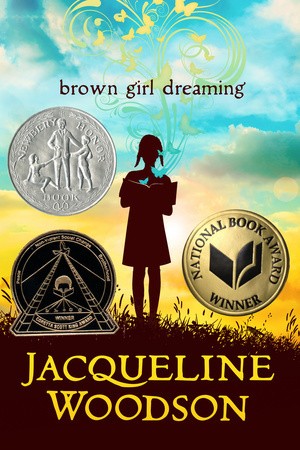
Brown Girl Dreaming
Jacqueline Woodson (2014)
“A childhood lived across the civil rights era, told in poems so precise they feel like memory itself — and a love letter to the power of words when the world refuses to hear you.”
Brown Girl Dreaming— Summary & Analysis
by Jacqueline Woodson · published 2014 · 337 pages · Contemporary
A user-friendly study guide for Brown Girl Dreaming by Jacqueline Woodson (2014): a high-level plot summary, full chapter-by-chapter analysis, theme breakdowns, character profiles, and 30 essay questions designed for middle-school, high-school readers. Unlike a stock summary, sumsumsum.com adds a diction analysis drawn from Jacqueline Woodson’s actual text, the 2 documented AP Literature exam appearances of this book, and reading-difficulty guidance (Easy, 1/10) so students, teachers, and lifelong readers know what they are walking into.
“A childhood lived across the civil rights era, told in poems so precise they feel like memory itself — and a love letter to the power of words when the world refuses to hear you.”
Short Summary
Jacqueline Woodson's memoir in verse traces her childhood from her birth in Ohio in 1963, through her early years in Greenville, South Carolina, raised by her mother's deeply religious family as the civil rights movement erupts around her, to her move to Brooklyn, New York, where she begins to find her voice as a writer. Told in spare, luminous free verse, the book is a portrait of a child caught between two worlds, two cities, two grandparents, and a country in the slow, painful act of changing.
Detailed Summary
Brown Girl Dreaming opens on February 12, 1963, with Jacqueline's birth in Columbus, Ohio, to parents who will soon separate. Her father, Jack Austin Woodson, is from South Carolina, and her mother, Mary Ann, takes the children back to her family in Greenville, South Carolina, when Jacqueline is ver...
Summary in the Author’s Writing Style
A retelling of Brown Girl Dreaming in Jacqueline Woodson’s style — so you can hear the language, not just the plot. This is a stylistic pastiche written by sumsumsum, not an excerpt from the book.
I am born in Ohio, February, the cold month, 1963, into a country that is arguing with itself about whether I am all the way human. My father's name is South Carolina. My mother's name is leaving. When the two stop fitting, my mother takes us back to Greenville, to her people, to the red dirt that …
Chapter-by-Chapter Analysis
If you liked Brown Girl Dreaming, read next
Start with Long Way Down by Jason Reynolds — Verse novel for young adults that uses the form to slow time and force reflection, as Woodson does — different subject (urban violence), same formal argument: poetry as the precise language for inner experience. Then try Genesis Begins Again by Alicia D. Williams — Contemporary middle-grade novel exploring Black girlhood, colorism, and identity with similar emotional honesty and refusal of easy resolution. Or pivot to March (trilogy) by John Lewis and Andrew Aydin — The civil rights movement from inside — Lewis's graphic memoir covers the same historical period but from the perspective of an adult activist rather than a child observer. Together they show the same era at two scales.
For comparative essays, pair Brown Girl Dreaming with
The strongest comparative pairing is The House on Mango Street (Sandra Cisneros) — Another coming-of-age memoir in lyric fragments — vignettes rather than poems, but the same instinct toward the short, precise, emotionally loaded form, and the same subject: a girl finding her voice in a neighborhood that doesn't expect her to have one. Another productive pairing is Roll of Thunder, Hear My Cry (Mildred D. Taylor) — The same rural Black Southern world in the same era — but prose fiction rather than verse memoir. Together they offer complementary approaches to the same historical experience. For a third angle, contrast with The Crossover (Kwame Alexander) — Another celebrated verse novel for young readers — where Woodson's verse is spare and elegiac, Alexander's is kinetic and rhythmic. Both prove the form can do more than traditional prose.
Each of these pairings opens a clean thesis path on shared themes, period diction, or formal influence — useful for AP Lit / IB / first-year college comparative essays.