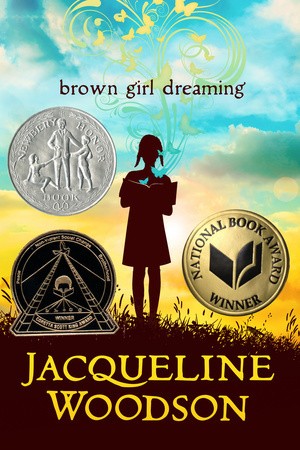
Brown Girl Dreaming
Jacqueline Woodson (2014)
“A childhood lived across the civil rights era, told in poems so precise they feel like memory itself — and a love letter to the power of words when the world refuses to hear you.”
For Students
Because here is a book that proves the child who cannot read the way other children read is not broken — and because the form shows you that poetry is not something separate from life, but the most accurate way to record it. Every poem is short enough to hold in your hand, and the whole book is one long argument that your specific story — exactly as strange and specific and painful and beautiful as it is — deserves to be told.
For Teachers
Because it teaches memoir, poetry, civil rights history, and close reading all at once, at any level from grade 5 through 12. The verse form makes annotation natural: you can analyze a single poem in ten minutes or a section in a week. The civil rights material is rendered from inside a child's experience, which means students engage emotionally before they engage historically — the pedagogically correct order. And it models for young writers the highest aspiration for personal experience: spare, honest, formally rigorous.
Why It Still Matters
Every student has felt they were not smart in the way they were supposed to be smart. Every student has felt they belonged more in some other place than where they are. And every student has a story that only they can tell. Brown Girl Dreaming is proof that the stories we carry in our bodies — the ones we cannot always read but always know — are worth the highest possible form of attention.