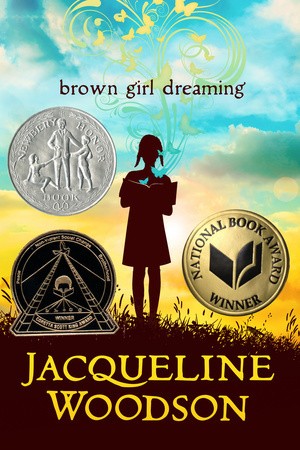
Brown Girl Dreaming
Jacqueline Woodson (2014)
“A childhood lived across the civil rights era, told in poems so precise they feel like memory itself — and a love letter to the power of words when the world refuses to hear you.”
Essay Questions & Food for Thought
30questions designed to challenge assumptions and provoke original thinking. These can't be answered from a summary — you need the actual text.
Why does Woodson choose to write her memoir in free verse rather than prose? What can a poem do that a paragraph of prose cannot, and what does this choice cost the reader?
Jacqueline cannot read well as a child, yet she becomes one of the most celebrated writers of her generation. What does this paradox tell us about the relationship between reading and writing — or between literacy and intelligence?
Woodson uses the same title for two different sections of the book: 'Followed by the Moon.' Why? What has changed about the moon's meaning between the first use and the second?
The civil rights movement appears at the edges of Jacqueline's childhood rather than at its center. Why might Woodson have made this choice? What would be lost if the movement were more explicitly present?
Woodson presents the grandmother's strict Jehovah's Witness faith without judging it — as a genuine survival strategy rather than an error. Do you agree with her portrayal? What does the faith give the family, and what does it cost them?
How does Greenville, South Carolina, function differently as a setting from Brooklyn, New York? What does each place represent — and why can Jacqueline not feel fully at home in either?
The book is dedicated, in part, to 'all the children who are still dreaming.' Who do you think Woodson means? Why frame the dedication that way rather than dedicating it to specific people?
Uncle Robert and Grandmother Georgiana have completely different ideas about how Black Americans should respond to racism. Woodson presents both without choosing one as correct. Is this a strength or a weakness of the book?
The grandfather's garden appears repeatedly throughout the Greenville sections. What does the garden represent beyond itself? Why does Woodson return to it as an image?
Woodson writes the memoir from a child's perspective even though she is an adult writing retrospectively. Where do you see the adult's knowledge intruding — even slightly — on the child's perspective? Is this a failure of the technique or an inevitability?
How does Woodson's use of white space on the page function as an emotional tool? Find three poems where what is NOT said seems as important as what is said.
Brown Girl Dreaming has been challenged and sometimes removed from school libraries. What do you think makes it threatening to some readers or communities? What does the fact of its challenging tell you about the book's power?
Compare the way Woodson handles her own family's complexity to how a traditional memoir might handle it. What would a prose memoir have included that Woodson's verse leaves out — and is that an omission or a choice?
The book's title uses 'dreaming' rather than 'dreamed.' Why the present tense? What does it say about the relationship between childhood and ongoing possibility?
Woodson was born on February 12 — Abraham Lincoln's birthday. She mentions this several times. Why does this coincidence matter to her, and what does she do with it in the book?
How does the book treat Jacqueline's mother differently from her grandparents? Why does the mother have less space on the page, and what does that absence tell us?
The book is classified as both memoir and poetry. What does it gain from being both? Could it have achieved the same effect as pure prose memoir, or as a poetry collection about an invented character?
How does Woodson's portrait of Greenville differ from the typical way the South is represented in American literature and film — as a backward, violent place to escape? What is her South?
Jacqueline's reading difficulty is a source of shame throughout most of the book. When, precisely, does that shame begin to lift? What changes it?
Compare Woodson's verse style to Gwendolyn Brooks or Lucille Clifton. What do these poets share, and what is distinctively Woodson's?
Woodson writes: 'Maybe I am not a liar. Maybe I am a person who imagines.' What is the difference, and why does the distinction matter so much to a child who will become a novelist?
The book ends before Jacqueline becomes a professional writer. Why end at the threshold rather than showing the achievement? What does that choice say about what the book is actually about?
How does Woodson represent the Great Migration — the movement of millions of Black Americans from South to North — through a single family's story? What does this intimate scale gain and lose compared to a historical account?
What does the book say about the relationship between having a voice and being heard? Are these the same thing, and which one does Jacqueline achieve by the end?
If you were teaching this book in a classroom, which three poems would you assign for close reading, and why those three? What would they collectively illuminate about the whole?
Woodson never addresses the reader directly as 'you,' yet the book feels deeply personal to readers of many different backgrounds. How does she achieve that intimacy without breaking the child's perspective to speak directly?
How does the book portray religious faith — not as a simple good or simple bad, but as something more complicated? Find evidence for multiple views of faith within the family itself.
Brown Girl Dreaming was published fifty years after the events it describes. How does that distance — writing in 2014 about 1963-1970 — shape what Woodson includes and excludes? What would the book look like if she had written it while living through it?
Woodson has said that she began writing the book as a way of understanding her own family. Does it read like a book written for herself, for young readers, or for both at once? Can those audiences coexist?
By the end of the book, what has Jacqueline found that she can carry from both Greenville and Brooklyn? What does the memoir finally say about the relationship between where you come from and who you become?