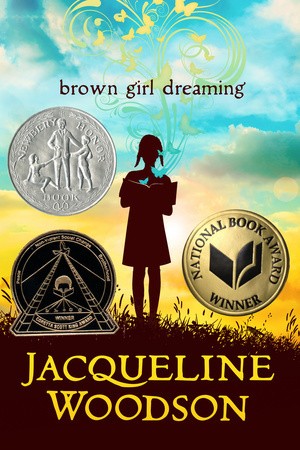
Brown Girl Dreaming
Jacqueline Woodson (2014)
“A childhood lived across the civil rights era, told in poems so precise they feel like memory itself — and a love letter to the power of words when the world refuses to hear you.”
Brown Girl Dreaming— Historical Context & Author Background
Author: Jacqueline Woodson · Published 2014· Era: Contemporary·337 pages
Themes explored: race, identity, family, south-vs-north, storytelling, belonging, civil-rights, voice
About Jacqueline Woodson
Jacqueline Woodson was born in Columbus, Ohio, in 1963 and grew up primarily in Greenville, South Carolina, and Brooklyn, New York — the exact geography of Brown Girl Dreaming. She was a slow reader as a child but a compulsive story-maker, and her eventual discovery that writing was her vocation mirrors the arc of the memoir precisely. She is now the author of more than thirty books for children and young adults, winner of the National Book Award for Brown Girl Dreaming (2014) and multiple Newbery Honor awards, and served as the National Ambassador for Young People's Literature from 2015 to 2017. She has spoken extensively about the experience of being a Black girl who loved stories in a country that did not always believe such stories deserved to be told.
Life → Text Connections
How Jacqueline Woodson's real experiences shaped specific elements of Brown Girl Dreaming.
Woodson grew up between Greenville, South Carolina, and Brooklyn, New York, moving back and forth through her childhood
The book's central tension between South and North, belonging and displacement, two cities and no single home
The geographical in-between-ness is not biographical background — it IS the book's argument. The writer's capacity for multiple perspectives came directly from the child's experience of multiple places.
Woodson was a slow reader as a child but a natural storyteller — she memorized and invented stories before she could transcribe them
Jacqueline's reading difficulty and shame, alongside her narrative gift, throughout the memoir
The paradox of the non-reading future writer is the book's central character arc. It is also a direct argument about the multiple ways a literary mind can work.
Woodson's family were Jehovah's Witnesses, and her grandmother's faith organized her Southern childhood
The grandmother's religious practice — no birthdays, no holidays, no Pledge — as both protection and isolation
The faith is not sentimentalized or condemned. It is rendered as the genuine thing it was: a survival system that came at real cost.
Woodson grew up during the civil rights movement — she was born in 1963, the year of the March on Washington
The movement at the edges of childhood, felt but not fully understood — a historical backdrop rendered from inside a child's partial perspective
Writing from the child's partial understanding rather than adult retrospective knowledge is the book's most important formal choice.
Historical Era
1963-1970s, American civil rights era and its aftermath, the Great Migration, desegregation of Southern cities
How the Era Shapes the Book
The civil rights era is not background decoration — it is the water the family swims in. The legal changes happening around Jacqueline's childhood are real changes, but they are experienced from below: the child feels the edges of the movement before she understands its shape. The fact that Woodson is born in 1963 — the year of the March on Washington, the year before the Civil Rights Act — means that the legal landscape of America is literally changing around her childhood. She grows up in the last years of official segregation and the first years of its legal dismantling, which means she experiences both.
Why Brown Girl Dreaming Matters Historically
Brown Girl Dreaming won the 2014 National Book Award for Young People's Literature and multiple Newbery Honor citations. It is one of the most decorated books in contemporary children's and young adult literature, and one of the first verse memoirs to reach a mainstream youth audience at the level of a major award. It reshaped what was considered possible for middle-grade memoir: showing that a Black girl's childhood was worthy of the highest formal ambition and the most prestigious literary recognition.
- One of the first verse memoirs for young people to win a major award (National Book Award, 2014)
- Demonstrated that spare free verse — not prose — could be the natural form for a young adult memoir
- One of the first major award winners to center the civil rights era from a child's interior perspective rather than as historical lesson
Frequently challenged and sometimes removed from school libraries for its treatment of race, its portrayal of the civil rights movement, and its honest representation of religious practice (Jehovah's Witness). Some challenges have come from communities that object to any curriculum that addresses race directly; others have come from religious communities objecting to the representation of faith. The challenges demonstrate the book's continued relevance: it is still capable of disturbing people who prefer not to be disturbed.