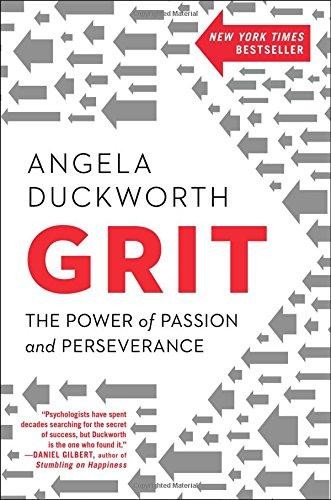
Grit: The Power of Passion and Perseverance
Angela Duckworth (2016)
“A psychologist who studied West Point cadets, National Spelling Bee champions, and rookie teachers in tough neighborhoods discovers that the secret to outstanding achievement is not talent but a special blend of passion and persistence she calls 'grit.'”
Grit: The Power of Passion and Perseverance— Historical Context & Author Background
Author: Angela Duckworth · Published 2016· Era: Contemporary Nonfiction·352 pages
Themes explored: perseverance, passion, talent, effort, deliberate-practice, purpose, resilience
About Angela Duckworth
Angela Lee Duckworth (born 1970) is a psychologist at the University of Pennsylvania whose research on grit has made her one of the most cited and discussed psychologists of the 21st century. She was awarded a MacArthur Fellowship (the 'genius grant') in 2013 for her work on grit and self-control. Duckworth's path to psychology was unconventional. She studied neurobiology at Harvard, then worked as a management consultant at McKinsey and Company, then became a math teacher in public schools in New York, San Francisco, and Philadelphia. It was her experience as a teacher — watching students of similar ability produce wildly different outcomes — that drove her to graduate school at the University of Pennsylvania, where she studied under Martin Seligman, the founder of positive psychology. Her teaching experience is central to the book's narrative and argument. Duckworth repeatedly returns to the puzzle she encountered in the classroom: why did some students with lower aptitude outperform peers with higher aptitude? The question was not academic for her — it was personal and urgent, born from watching real children succeed or struggle in real time. Duckworth's research has been enormously influential and also significantly contested. The grit concept has been adopted by schools, military academies, and corporations worldwide. The Grit Scale has been administered to millions of people. At the same time, replication studies have produced mixed results, critics have questioned whether grit is distinct from existing constructs like conscientiousness, and concerns have been raised about using grit to evaluate students or employees from disadvantaged backgrounds.
Life → Text Connections
How Angela Duckworth's real experiences shaped specific elements of Grit: The Power of Passion and Perseverance.
Experience as a public school math teacher watching students of equal ability produce different outcomes
The core puzzle that launches the book — why do some talented students fail while less talented peers succeed?
Duckworth's question emerged from direct observation, not theory, giving it emotional authenticity and practical urgency
Daughter of a Chinese immigrant scientist who repeatedly told her she was 'no genius'
Her father's dismissal of her potential became a motivating force — she set out to prove that non-geniuses can achieve extraordinary things through effort
The personal sting of being told she wasn't exceptional enough gave Duckworth's research a biographical drive that transcends academic curiosity
MacArthur 'genius grant' recipient
The irony is acknowledged in the book — being called a 'genius' for studying how effort matters more than genius
The award validated her research while also highlighting the cultural bias toward talent labels that she studies
Historical Era
The character education and positive psychology movement (2010s)
How the Era Shapes the Book
Grit was published at a moment when educators, parents, and policymakers were intensely interested in 'non-cognitive skills' — the character traits, habits of mind, and motivational patterns that shape achievement beyond what IQ and test scores measure. The positive psychology movement had created an intellectual framework for studying human strengths rather than deficits. Growing concerns about over-protected, under-challenged children ('snowplow parenting') created a cultural appetite for a message about the value of struggle and persistence. And the charter school movement, particularly KIPP's explicit focus on character development, provided real-world laboratories for testing whether grit could be taught. Duckworth's book both reflected and amplified these trends, becoming a touchstone for the character education movement while also drawing significant pushback from critics who worried that emphasizing individual grit could distract from structural barriers to achievement.
Why Grit: The Power of Passion and Perseverance Matters Historically
Grit introduced a measurable construct — the combination of passion and perseverance — that reframed the conversation about achievement from talent identification to effort cultivation. The concept has been adopted by schools, military programs, athletic organizations, and corporations worldwide, and has become one of the most discussed and debated ideas in contemporary psychology.
- Developed the Grit Scale — a validated self-report measure of passion and perseverance that has been administered to millions
- Demonstrated through controlled research that grit predicts achievement beyond what IQ, talent, and standardized test scores predict
- Formalized the effort equation (Talent x Effort = Skill; Skill x Effort = Achievement) as a concise challenge to the talent myth
- Connected disparate research traditions — deliberate practice, growth mindset, learned optimism — into a unified framework for understanding sustained achievement
Not banned, but the subject of significant controversy. Critics from education, sociology, and psychology have raised concerns about: the framework's potential to blame individuals for systemic failures (telling a student in a failing school to 'be grittier' rather than fixing the school); the Grit Scale's overlap with existing personality measures (particularly the Big Five trait of conscientiousness); replication difficulties with some foundational studies; and the ethics of measuring and evaluating grit in students, particularly those from disadvantaged backgrounds.