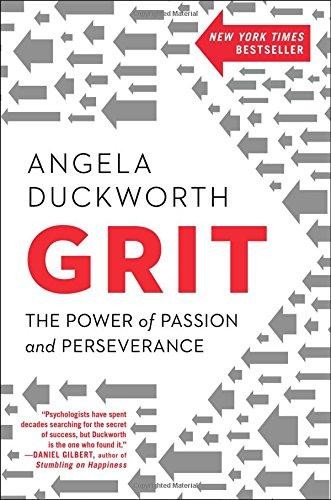
Grit: The Power of Passion and Perseverance
Angela Duckworth (2016)
“A psychologist who studied West Point cadets, National Spelling Bee champions, and rookie teachers in tough neighborhoods discovers that the secret to outstanding achievement is not talent but a special blend of passion and persistence she calls 'grit.'”
Grit: The Power of Passion and Perseverance— Diction & Style Analysis
Language Register
Moderately informal. Duckworth uses first-person narrative extensively, shares personal anecdotes, and addresses the reader conversationally. But she maintains scientific rigor through precise citation of research, careful distinction between correlation and causation, and honest acknowledgment of her framework's limitations. The informality creates rapport; the rigor creates trust.
Syntax Profile
Medium-length sentences that alternate between narrative (story-driven, character-oriented) and analytical (evidence-driven, claim-oriented) modes. Duckworth uses parallel constructions to define and distinguish concepts (passion AND perseverance, not passion OR perseverance) and builds arguments through accumulation of examples rather than logical deduction.
Figurative Language
Moderate. Duckworth uses metaphors strategically — the 'treadmill' of talent that goes nowhere without effort, 'scaffolding' for the support structures that help grit develop, and the 'cathedral' for work connected to purpose. The metaphors are concrete and functional, serving as memory aids for abstract concepts.
Era-Specific Language
Passion and perseverance for long-term goals — Duckworth's coined construct
Effortful, targeted practice at the edge of current ability — borrowed from Ericsson
Belief that abilities can be developed — borrowed from Dweck
Family rule requiring everyone to do one hard thing they can't quit mid-commitment
How Characters Speak — Class & Identity
West Point cadets
Highly selected, predominantly middle-to-upper-class population
The foundational research was conducted with an elite population, which raises questions about generalizability to populations facing structural barriers to achievement
Spelling Bee contestants
Predominantly upper-middle-class families with resources for intensive preparation
The conditions that produce spelling bee success — parental support, access to coaching, financial stability — are not equally available, complicating the 'anyone can be gritty' message
Chicago public school students
Diverse socioeconomic population facing real structural barriers
Duckworth's research with lower-income populations adds nuance — grit matters even in challenging conditions, but the conditions themselves limit outcomes
Duckworth herself
Daughter of immigrant scientist, McKinsey consultant, Ivy League professor
Duckworth's own biography demonstrates grit but also significant structural advantages — education, connections, financial security — that she acknowledges imperfectly
Narrator's Voice
Candid researcher — Duckworth writes with the confidence of someone who has done the work and the humility of someone who knows that no single framework explains everything. She is more willing than most popular psychology authors to acknowledge the limitations of her research, which paradoxically strengthens her credibility.
Tone Progression
Part I
Provocative and evidence-building
Duckworth challenges the talent myth with counterintuitive research findings, building a case through surprise and data.
Part II
Developmental and practical
The tone shifts toward how grit develops, with a warmer, more instructional quality — less 'you're wrong about talent' and more 'here's how to build grit.'
Part III
Expansive and reflective
The final section broadens to culture and structure, and the tone becomes more measured and qualified as Duckworth acknowledges complexity.
Stylistic Comparisons
- Carol Dweck (Mindset) — shared intellectual territory (both study persistence and belief about ability), but Duckworth is more data-driven and less framework-driven; Dweck provides the cognitive foundation, Duckworth provides the behavioral superstructure
- Malcolm Gladwell (Outliers) — both challenge the talent myth, but Gladwell emphasizes structural factors (opportunity, culture) while Duckworth emphasizes individual psychology (passion, perseverance)
- Anders Ericsson (Peak) — Ericsson provides the technical science of practice that Duckworth popularizes; Duckworth adds the motivational dimension (why people practice) to Ericsson's procedural dimension (how people should practice)
- Paul Tough (How Children Succeed) — both address character development in education, but Tough focuses more on childhood adversity and structural factors while Duckworth focuses on individual traits and interventions