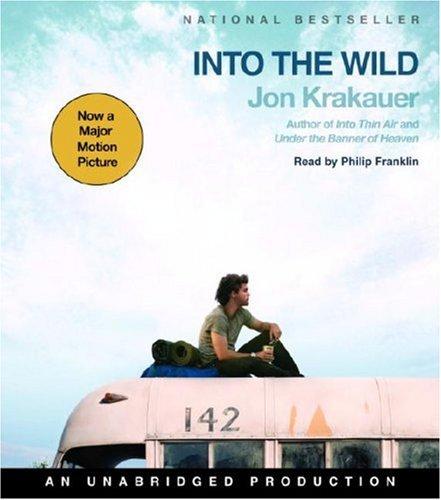
Into the Wild
Jon Krakauer (1996)
“A young man walked away from everything America told him to want — and died for it. Jon Krakauer can't stop thinking about why.”
Into the Wild— Historical Context & Author Background
Author: Jon Krakauer · Published 1996· Era: Contemporary Nonfiction·224 pages
Themes explored: freedom, nature, identity, family, idealism, survival, materialism, solitude
About Jon Krakauer
Jon Krakauer (born 1954) grew up in Corvallis, Oregon, the son of a doctor who wanted him to follow a medical or academic path. He became obsessed with mountain climbing as a teenager and spent his twenties working manual jobs — carpenter, fisherman, cannery worker — to fund climbing expeditions. His relationship with his father was strained by his rejection of conventional success. He became a writer partly because it allowed him to climb for work. His magazine assignment on McCandless became personally consuming when he recognized in McCandless not a tragedy to report but a version of himself he might have been. His own near-death solo climb of the Devil's Thumb in Alaska is the book's emotional anchor.
Life → Text Connections
How Jon Krakauer's real experiences shaped specific elements of Into the Wild.
Krakauer's father wanted him to become a doctor; Krakauer chose climbing and writing, producing years of tension and disappointment
Walt McCandless's high expectations and the rupture when Chris refused to follow a conventional path after Emory
Krakauer's father-son story rhymes with McCandless's. The author's bias is not hidden — it's built into the structure of the book.
Krakauer's solo attempt on the Devil's Thumb in his twenties — a deliberately dangerous, lonely expedition driven by a need to prove something
The Devil's Thumb chapter, inserted mid-book, in which Krakauer is nearly killed and survives by luck
Krakauer cannot distance himself from McCandless because he made the same choices. The book is partly a confession.
Krakauer worked as a carpenter and cannery laborer for years, choosing physical work over career advancement to fund his climbing
McCandless's grain elevator and McDonald's work — meaningful employment chosen freely rather than career-driven
Both men understood the dignity of manual work and its relationship to freedom. This shared experience shapes Krakauer's sympathy.
Krakauer is a trained journalist who learned to separate his own feelings from reportage — but admits he couldn't fully do that here
The book's openly argumentative stance: Krakauer defends McCandless against the verdict that he was simply foolish
Into the Wild is honest about its own partiality in a way that most journalism is not. The defense is transparent, which makes it more trustworthy, not less.
Historical Era
Early 1990s — post-Cold War America, late-stage consumer culture, environmental awakening
How the Era Shapes the Book
McCandless graduated into an America of material abundance and political exhaustion. The Cold War was over; there were no great causes. He rejected the path his parents' generation had built — stable career, suburban comfort, upward mobility — and looked for meaning in what couldn't be bought. His story resonated with a generation that shared his discomfort but not his courage or recklessness.
Why Into the Wild Matters Historically
Into the Wild spent two years on the New York Times bestseller list after publication and has never gone out of print. It transformed a coroner's report into one of the most debated questions in American culture: was McCandless a hero or a fool? The debate — conducted in classrooms, online, and in the letters Krakauer still receives — has not resolved. That unresolvability is the book's gift.
- One of the first works of literary journalism to take wilderness idealism seriously as philosophy rather than pathology
- Established the template for the 'misfit-in-nature' nonfiction genre that followed (Wild, A Walk in the Woods)
- Pioneered the open insertion of the author's personal biography into a profile — making subjectivity a structural feature rather than a flaw to conceal
Challenged in some school districts for allegedly romanticizing dangerous behavior and encouraging young people to leave home. The irony — that the book's actual argument is considerably more ambivalent than 'leave home and die beautifully' — is lost on most challengers.