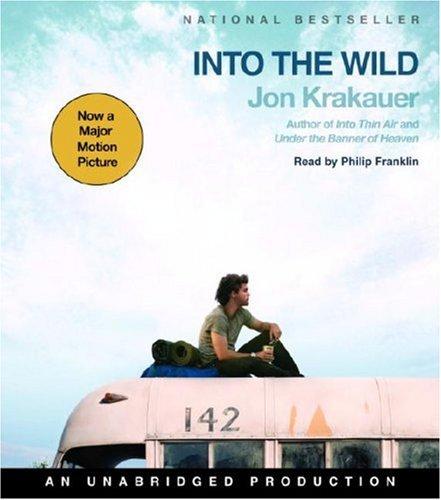
Into the Wild
Jon Krakauer (1996)
“A young man walked away from everything America told him to want — and died for it. Jon Krakauer can't stop thinking about why.”
Essay Questions & Food for Thought
30questions designed to challenge assumptions and provoke original thinking. These can't be answered from a summary — you need the actual text.
Krakauer is openly sympathetic to McCandless throughout the book. Does this make him more or less trustworthy as a narrator? Can a journalist advocate for a subject and still report accurately?
McCandless's final journal entry may have been 'HAPPINESS ONLY REAL WHEN SHARED.' If true, does this represent a conversion from his philosophy, or its completion? Did he change his mind at the end?
The book is non-chronological — we know McCandless dies before we know how he lived. How does this structure shape your response to him? Would the book be more or less sympathetic told chronologically?
Every person McCandless met found him charismatic and worrying in equal measure. What does this tell us about charisma? Is it possible to be genuinely charming and genuinely irresponsible simultaneously?
McCandless donated his $24,000 savings to OXFAM and burned his remaining cash. Is this admirable, irresponsible, or both? What does money represent to him, and what is he trying to destroy when he destroys it?
Walt McCandless preached honesty to his children while maintaining a secret second family. How much of Chris's flight was a response to this specific hypocrisy, and how much would have happened anyway?
Ron Franz offered to adopt McCandless as his grandson. McCandless declined and instead encouraged Franz to abandon his comfort and move into the wild. Was this advice kind, cruel, or simply honest?
Krakauer inserts his own near-death on the Devil's Thumb into the middle of McCandless's story. Does this make the book better or does it hijack McCandless's story for Krakauer's own?
If McCandless had survived — walked out of Alaska healthy — would we celebrate him or pity him? What does the death add to his story that survival would remove?
McCandless was a college graduate who chose manual labor (grain elevator, McDonald's). Krakauer was an Ivy League-caliber writer who chose carpentry. What is the relationship between education, privilege, and the choice to work with your hands?
The Teklanika River that trapped McCandless would have been crossable with the information on a topographic map he didn't have. Is this a tragedy of ignorance, arrogance, or simply bad luck?
Krakauer presents three parallel wilderness deaths alongside McCandless: Ruess, Waterman, and McCunn. What is the argument this comparison is making? Do you find it persuasive?
McCandless wrote 'Jack London is King' in his journal. London's fiction celebrated wilderness survival; London himself died of a combination of diseases and alcohol at forty. What does McCandless's choice of literary hero reveal about how he read books?
Several critics argued McCandless was simply a spoiled rich kid playing at poverty. Krakauer argues the opposite. Who do you think is right, and what evidence from the text supports your view?
The book was published in 1996 and became a bestseller partly because readers recognized something in McCandless. What cultural moment made his story resonate then? Does it still resonate now, and for the same reasons?
Bus 142 was airlifted out of the Alaskan wilderness in 2020 because too many hikers were attempting the Stampede Trail and requiring rescue. Is McCandless responsible for those deaths and rescues? Is Krakauer?
McCandless wrote extensively in his journal and annotated his books heavily. He was clearly constructing a narrative of his own life. Does this make him admirable (self-aware) or worrying (performing for an audience that didn't exist)?
Krakauer suggests McCandless was poisoned by wild potato seeds, possibly accelerating his starvation. Scientists have disputed this. Does the cause of death matter to the meaning of the story? Would it change your reading if he simply starved with no other explanation?
Thoreau's Walden — which McCandless read and annotated — was written by a man who walked to his mother's house for dinner regularly. Does knowing this change how you read McCandless's Thoreauvian idealism?
Why did McCandless shed his identity — birth name, social security number, ID — so deliberately? What does identity consist of, and what does he gain by destroying it?
Into the Wild is a book by a man who survived written about a man who didn't. How does Krakauer's survival shape his interpretation? Can he be fully trustworthy about a death he came close to but avoided?
McCandless refused a map for the Stampede Trail. Many readers see this as fatal arrogance. Others see it as a genuine philosophical commitment to unmediated experience. Can you defend the choice, even knowing the outcome?
Every person who loved McCandless tried to get him to stay: Westerberg, Jan Burres, Ron Franz, Jim Gallien. He refused all of them. What does this pattern reveal about his relationship to love and attachment?
Compare McCandless's idealism to political idealism: people who reject compromise in pursuit of a purer vision. What are the similarities? What are the limits of this comparison?
Krakauer describes Alaska's appeal for a specific type of young American seeking self-erasure. Why Alaska in particular? What does wilderness represent that cities and suburbs cannot provide?
Into the Wild could be read as a critique of American materialism. But McCandless came from a family that worked hard for its material comfort. Is rejecting your parents' achievement the same as rejecting materialism itself?
The book was criticized for being 'dangerous' — inspiring imitators who got hurt. Is an author responsible for how readers apply their work? Should Krakauer have written a less sympathetic portrait?
McCandless annotated his books heavily, especially Tolstoy, London, and Thoreau. Find a passage from one of those authors online and read it. How does knowing the source texts change your understanding of what McCandless was attempting?
Krakauer ends with ambivalence, not resolution. Is this intellectually honest or is it a failure to take a position? What verdict would you reach about McCandless if you had to give one?
In 2020, the state of Alaska airlifted bus 142 to a museum. The wilderness preserved it, then civilization claimed it. Is there an irony here that McCandless would have recognized? What would he have thought about his bus becoming an exhibit?