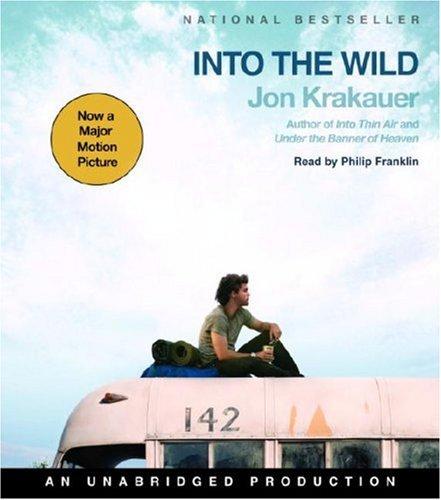
Into the Wild
Jon Krakauer (1996)
“A young man walked away from everything America told him to want — and died for it. Jon Krakauer can't stop thinking about why.”
Language Register
Clear, precise, accessible — investigative journalism raised to literary standard. Krakauer's own voice is measured; McCandless's voice (in letters and journal excerpts) is romantic and declamatory.
Syntax Profile
Krakauer's sentences are clean and medium-length — closer to magazine prose than literary fiction. He constructs chapters as a journalist would: lead, evidence, analysis, complication. McCandless's own writing, reproduced throughout, is conspicuously different: longer, more formal, prone to capital letters and exclamation points. The two registers in collision is the book's central textual drama.
Figurative Language
Moderate — Krakauer uses metaphor purposefully rather than ornamentally. Alaska itself does much of the figurative work: the river, the bus, the snow, the silence. He avoids simile in the wilderness sections, letting physical description carry the symbolic weight.
Era-Specific Language
Traveler who lives out of a vehicle, as opposed to 'leather tramp' (on foot)
To sink into deep snow with each step — a specific mountaineering hardship
Mail system allowing itinerants to receive letters at a post office without a fixed address
McCandless's self-chosen alias — a reference to independence from the working world
Alaskan term for undeveloped wilderness, remote from roads and towns
How Characters Speak — Class & Identity
Chris McCandless
His writing is formal and literary — full of allusion to Tolstoy, London, Thoreau, Byron. His speech (reported by witnesses) was direct and egalitarian.
Emory-educated idealist performing voluntary poverty. The literary register of his journal signals that he was always constructing a narrative, not just living one.
Krakauer-as-narrator
Journalistic, precise, deliberately unshowy. He suppresses the literary voice he has when writing about himself to report McCandless more objectively.
A professional writer who knows his own tendencies and guards against them. The restraint is itself a form of respect.
Wayne Westerberg
Plain-spoken, Midwestern, concrete. Talks in specifics. 'Best worker I ever had' rather than 'an exceptional employee.'
Working-class credibility that McCandless deliberately sought out. Westerberg's plainness grounds the romantic in the practical.
Ron Franz
Formal but warm — Army-inflected directness with unexpected emotional openness. His testimony is the most unguarded in the book.
An old man who has lost everyone and has nothing left to protect. He doesn't perform grief; he exhibits it.
Walt and Billie McCandless
Careful, measured, defensive in the early conversation; increasingly raw. Walt uses engineering vocabulary to describe emotional situations.
Upper-middle-class professional family managing catastrophic grief in the register they know: controlled articulation. The control cracks.
Narrator's Voice
Krakauer: a journalist who became personally invested. The book is nominally a magazine piece expanded — but the expansion revealed something he couldn't resolve in 8,000 words. He is not objective; he argues for McCandless openly. But he earns the argument through evidence rather than sentiment.
Tone Progression
Chapters 1-2 (Discovery)
Forensic, controlled, restrained
Krakauer establishes what is known and what cannot be known. The prose is precise. Emotion is deferred.
Chapters 3-6 (The Journey)
Warm, investigative, increasingly complex
The interviews reveal a McCandless who is lovable and maddening. Krakauer's prose relaxes as the portrait gains texture.
Chapters 7-8 (Parallel Lives)
Essayistic, autobiographical, vulnerable
Krakauer steps into the frame. The argument is being made, not just reported.
Chapters 9-10 (Family and Death)
Elegiac, careful, honest
The grief is allowed in without sentimentality. The final chapter is Krakauer at his most restrained — letting the evidence do what emotion cannot.
Stylistic Comparisons
- Sebastian Junger's The Perfect Storm — same long-form journalism expanded to book; same question: why do men court death?
- John Krakauer's Into Thin Air — Krakauer's own near-death in a larger group; the companion piece to this solo story
- Thoreau's Walden — McCandless's explicit philosophical model; Into the Wild is partly an argument about what Thoreau actually meant
Key Vocabulary from This Book
Notable words used in this text — click to see full definitions