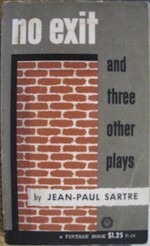
No Exit
Jean-Paul Sartre (1944)
“Three damned souls locked in a drawing room discover that hell needs no torture chambers -- only other people.”
At a Glance
Joseph Garcin, a Brazilian journalist who deserted during wartime, arrives in a Second Empire drawing room that turns out to be hell. He is joined by Ines Serrano, a cruel and perceptive postal clerk, and Estelle Rigault, a vain socialite who drowned her infant. There are no mirrors, no eyelids, no sleep. Each character needs something from one of the others that the third will never allow: Garcin needs Ines to validate his courage, Estelle needs Garcin's desire, Ines needs Estelle's love. The door opens; no one leaves. Garcin delivers the play's famous verdict: 'Hell is other people.'
Read full summary →Why This Book Matters
No Exit made existentialism accessible to millions who would never read Being and Nothingness. The phrase 'Hell is other people' entered common language across cultures, though almost always misquoted to mean simple misanthropy rather than Sartre's precise point about self-definition through others' judgment. The play demonstrated that philosophical drama could be commercially successful, paving the way for the Theatre of the Absurd.
Diction Profile
Formal drawing-room French translated into precise English -- philosophical argument embedded in conversational dialogue
Very low -- deliberately. Sartre avoids metaphor because metaphor permits evasion. The play's power comes from literal statement: there are no mirrors, the eyelids don't work, the door opens and no one leaves. Every significant element is concrete and theatrical, not figurative. The one major symbol -- the bronze ornament on the mantelpiece -- is treated as an ugly object, not a carrier of meaning.