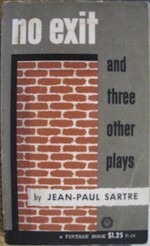
No Exit
Jean-Paul Sartre (1944)
“Three damned souls locked in a drawing room discover that hell needs no torture chambers -- only other people.”
No Exit— Summary & Analysis
by Jean-Paul Sartre · published 1944 · 46 pages · Existentialist
A user-friendly study guide for No Exit by Jean-Paul Sartre (1944): a high-level plot summary, full chapter-by-chapter analysis, theme breakdowns, character profiles, and 30 essay questions designed for high-school, ap-english, college readers. Unlike a stock summary, sumsumsum.com adds a diction analysis drawn from Jean-Paul Sartre’s actual text, the 6 documented AP Literature exam appearances of this book, and reading-difficulty guidance (Easy, 3/10) so students, teachers, and lifelong readers know what they are walking into.
“Three damned souls locked in a drawing room discover that hell needs no torture chambers -- only other people.”
Short Summary
Joseph Garcin, a Brazilian journalist who deserted during wartime, arrives in a Second Empire drawing room that turns out to be hell. He is joined by Ines Serrano, a cruel and perceptive postal clerk, and Estelle Rigault, a vain socialite who drowned her infant. There are no mirrors, no eyelids, no sleep. Each character needs something from one of the others that the third will never allow: Garcin needs Ines to validate his courage, Estelle needs Garcin's desire, Ines needs Estelle's love. The door opens; no one leaves. Garcin delivers the play's famous verdict: 'Hell is other people.'
Detailed Summary
A Valet leads Joseph Garcin into a windowless drawing room furnished in Second Empire style. There are no mirrors, no beds, no switches for the lights, and no way to close one's eyes -- the eyelids no longer work. Garcin, a Rio de Janeiro journalist and self-proclaimed pacifist, initially expects fi...
Summary in the Author’s Writing Style
A retelling of No Exit in Jean-Paul Sartre’s style — so you can hear the language, not just the plot. This is a stylistic pastiche written by sumsumsum, not an excerpt from the book.
The Valet opens the door. Garcin steps in and looks around. A drawing room, Second Empire. A sofa, a few armchairs, a bronze thing on the mantelpiece. No window. No mirror. No bed. GARCIN: Where are the instruments of torture? VALET: There aren't any. GARCIN: I expected fire. Stakes. Red-hot pinc…
Chapter-by-Chapter Analysis
If you liked No Exit, read next
Start with Waiting for Godot by Samuel Beckett — Same locked-room existential stasis -- but Beckett removes the philosophical argument and leaves only the waiting. Then try The Stranger by Albert Camus — Existentialism's other founding text -- Meursault's radical indifference is the inverse of Garcin's desperate need for judgment. Or pivot to The Trial by Franz Kafka — Another vision of judgment without a judge -- Kafka's bureaucratic absurdity prefigures Sartre's polite Valet and institutional hell.
More from Jean-Paul Sartre and the scholars who study Sartre
Other works by Jean-Paul Sartre: Nausea (1938, 253 pages). Reading two or three of these in sequence reveals Jean-Paul Sartre’s recurring obsessions and stylistic signatures more clearly than any single book can.