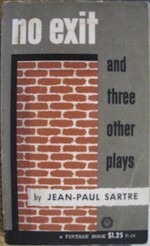
No Exit
Jean-Paul Sartre (1944)
“Three damned souls locked in a drawing room discover that hell needs no torture chambers -- only other people.”
This page prints on a single page. Use Ctrl+P / Cmd+P.
No Exit
Jean-Paul Sartre (1944) · 46pages · Existentialist · 6 AP appearances
Summary
Joseph Garcin, a Brazilian journalist who deserted during wartime, arrives in a Second Empire drawing room that turns out to be hell. He is joined by Ines Serrano, a cruel and perceptive postal clerk, and Estelle Rigault, a vain socialite who drowned her infant. There are no mirrors, no eyelids, no sleep. Each character needs something from one of the others that the third will never allow: Garcin needs Ines to validate his courage, Estelle needs Garcin's desire, Ines needs Estelle's love. The door opens; no one leaves. Garcin delivers the play's famous verdict: 'Hell is other people.'
Why It Matters
No Exit made existentialism accessible to millions who would never read Being and Nothingness. The phrase 'Hell is other people' entered common language across cultures, though almost always misquoted to mean simple misanthropy rather than Sartre's precise point about self-definition through othe...
Themes & Motifs
Diction & Style
Register: Formal drawing-room French translated into precise English -- philosophical argument embedded in conversational dialogue
Narrator: No narrator -- the play is entirely dialogue and stage direction. Sartre's stage directions are sparse and functional...
Figurative Language: Very low -- deliberately. Sartre avoids metaphor because metaphor permits evasion. The play's power comes from literal statement: there are no mirrors, the eyelids don't work, the door opens and no one leaves. Every significant element is concrete and theatrical, not figurative. The one major symbol -- the bronze ornament on the mantelpiece -- is treated as an ugly object, not a carrier of meaning.
Historical Context
1944 Occupied Paris -- WWII, Nazi occupation, French Resistance, existentialism emerging: No Exit was written by a former POW during a military occupation in which every citizen faced Garcin's question: when the moment came, did you act with courage or with cowardice? The Occupation mad...
Key Characters
Talking Points
- Why does Sartre set hell in a Second Empire drawing room rather than a dungeon or a lake of fire? What does the choice of bourgeois furniture tell us about the kind of hell he is constructing?
- Garcin claims that 'a man is what he wills himself to be' -- a core existentialist principle. Why can't he live by this principle? What does his failure suggest about the gap between knowing a philosophy and embodying it?
- 'Hell is other people' is commonly understood as meaning 'other people are annoying.' What does Sartre actually mean? Use specific scenes from the play to explain the real philosophical argument.
- The door opens and no one leaves. Why? Each character has a different reason for staying -- what are they, and what do those reasons reveal about each character's mode of bad faith?
- Ines is the play's clearest thinker -- she sees through everyone's pretenses. Yet she is also the cruelest character. Does Sartre present lucidity as a virtue, a weapon, or both? Can you be fully honest and fully kind?
Notable Quotes
“So this is hell. I'd never have believed it. You remember all we were told about the torture-chambers, the fire and brimstone, the 'burning marl.' ...”
“One never sleeps here. Why should one? Sleep is for the living.”
“I prefer to choose my hell; I prefer to look you in the eyes and fight it out face to face.”
Why Read This
Because at 46 pages, No Exit delivers more philosophical density per sentence than most novels manage in 400. You can read it in an hour and argue about it for a semester. The play teaches you how to think about identity, freedom, self-deception, ...