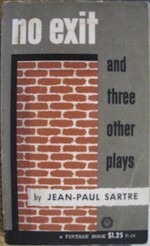
No Exit
Jean-Paul Sartre (1944)
“Three damned souls locked in a drawing room discover that hell needs no torture chambers -- only other people.”
Language Register
Formal drawing-room French translated into precise English -- philosophical argument embedded in conversational dialogue
Syntax Profile
Sartre writes in deceptively ordinary sentences -- subject-verb-object, few subordinate clauses, almost no figurative language. The simplicity is strategic: philosophical ideas emerge from plain speech rather than poetic elaboration. Dialogue moves rapidly, with frequent interruptions. Speeches rarely exceed five sentences before another character cuts in. The rhythm is conversational, almost sitcom-like, which makes the philosophical content land harder.
Figurative Language
Very low -- deliberately. Sartre avoids metaphor because metaphor permits evasion. The play's power comes from literal statement: there are no mirrors, the eyelids don't work, the door opens and no one leaves. Every significant element is concrete and theatrical, not figurative. The one major symbol -- the bronze ornament on the mantelpiece -- is treated as an ugly object, not a carrier of meaning.
Era-Specific Language
Decorative style of Napoleon III's France (1852-1870) -- the furniture signals bourgeois respectability and historical decay
Self-deception about one's freedom -- the central Sartrean concept dramatized through each character
A letter opener -- bourgeois desk accessory turned impotent weapon, also a nod to Sartre's famous 'essence precedes existence' example
The Other's gaze that objectifies the self -- never named in the play but structurally omnipresent
Hell's functionary -- bureaucratic, indifferent, the system's human face
How Characters Speak — Class & Identity
Garcin
Educated, formal, slightly professorial. Tends toward abstract formulations ('a man is what he wills himself to be'). Uses rhetorical questions to control conversations. Avoids vulgarity.
Middle-class intellectual who has constructed an identity around moral seriousness. His language is his armor -- if he speaks like a man of principle, perhaps he is one.
Ines Serrano
Blunt, direct, economical. Short declarative sentences. No hedging, no social pleasantries. Uses 'you' as an accusation. Speaks the way she sees: without ornament.
Working-class clarity. Ines has no inherited social register to perform; she speaks from a position that has never required diplomacy. Her directness is both authenticity and aggression.
Estelle Rigault
Salon French -- diminutives, exclamations, appeals to propriety ('How dare you!', 'But that's not fair!'). Shifts to breathless fragments when her composure cracks. Uses euphemism compulsively.
Upper-class performance. Every sentence is designed to manage others' perceptions. Even in hell, she cannot stop deploying the language of Parisian social propriety. The euphemisms are how she hides from herself.
The Valet
Polite, formulaic, slightly amused. Service-industry diction -- 'as you wish,' 'I'm afraid that's not possible.' Never volunteers information.
Hell as bureaucracy. The Valet speaks the language of institutional indifference -- the same register as a hotel concierge, a civil servant, or a prison guard who follows orders without malice.
Narrator's Voice
No narrator -- the play is entirely dialogue and stage direction. Sartre's stage directions are sparse and functional ('Garcin sits down. Silence.'). The absence of a narrative voice is itself philosophical: there is no external authority to interpret or judge. The characters must do it themselves, which is precisely the problem.
Tone Progression
Garcin's Arrival
Disoriented, darkly comic
The gap between Garcin's expectations (fire, brimstone) and reality (upholstery) produces comedy. The Valet's politeness is absurd.
Ines and Estelle Arrive
Wary, sharp, socially tense
Three strangers forced into proximity. The tone is that of an uncomfortable dinner party where everyone is hiding something.
Visions and Confessions
Increasingly raw, confessional
The social masks crack. The language becomes more direct, more desperate. The comedy evaporates.
Failed Alliances and Final Scene
Desperate, claustrophobic, grimly lucid
All pretense exhausted. The open door scene is played at emotional extremity. The final laughter is not relief but recognition.
Stylistic Comparisons
- Beckett's Waiting for Godot -- same claustrophobic stasis, but Beckett removes meaning where Sartre insists on too much of it
- Camus's The Stranger -- similar existentialist register but Meursault's flatness is the opposite of Sartre's argumentative intensity
- Pinter's The Homecoming -- same drawing-room menace, but Pinter weaponizes silence where Sartre weaponizes speech
Key Vocabulary from This Book
Notable words used in this text — click to see full definitions