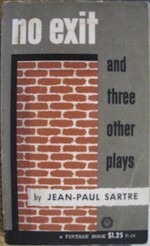
No Exit
Jean-Paul Sartre (1944)
“Three damned souls locked in a drawing room discover that hell needs no torture chambers -- only other people.”
Why This Book Matters
No Exit made existentialism accessible to millions who would never read Being and Nothingness. The phrase 'Hell is other people' entered common language across cultures, though almost always misquoted to mean simple misanthropy rather than Sartre's precise point about self-definition through others' judgment. The play demonstrated that philosophical drama could be commercially successful, paving the way for the Theatre of the Absurd.
Firsts & Innovations
One of the first plays to present existentialist philosophy in fully dramatic form -- not as lecture but as lived experience
Pioneered the 'locked room' structure as philosophical thought experiment in drama
One of the earliest mainstream theatrical works to include an openly lesbian character whose sexuality is treated as fact rather than pathology
Cultural Impact
'Hell is other people' became one of the most quoted -- and misquoted -- phrases in modern philosophy
The locked-room structure influenced decades of drama, film, and television (from Twilight Zone to Cube to Saw)
Introduced existentialist vocabulary (bad faith, the gaze, radical freedom) to general audiences worldwide
Performed continuously since 1944 -- one of the most frequently produced plays in the French repertoire
Standard text in philosophy courses as well as literature courses -- rare crossover status
Banned & Challenged
Challenged periodically for sexual content (Ines's lesbianism, Estelle's infanticide) and for its atheist framing of the afterlife -- hell without God, damnation without divine authority. The play's suggestion that humans create their own hell, rather than receiving it as divine punishment, remains theologically provocative.