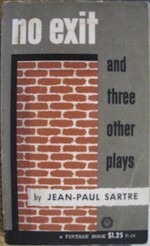
No Exit
Jean-Paul Sartre (1944)
“Three damned souls locked in a drawing room discover that hell needs no torture chambers -- only other people.”
For Students
Because at 46 pages, No Exit delivers more philosophical density per sentence than most novels manage in 400. You can read it in an hour and argue about it for a semester. The play teaches you how to think about identity, freedom, self-deception, and the way other people shape who you are -- questions that matter more at 17 than at any other age. And Sartre's most famous line is probably tattooed on someone at your school, so you should know what it actually means.
For Teachers
Short enough to teach in two class periods, dense enough for a full unit. The triangular structure makes it ideal for in-class dramatic reading. Every scene supports close analysis of diction, dramatic irony, and philosophical argument simultaneously. The play connects naturally to Sartre's nonfiction, to Camus, to Beckett, and to any unit on existentialism, modernism, or the philosophy of identity. Students who resist novels often engage with plays, and this one rewards every level of reading.
Why It Still Matters
Social media is Sartre's room: you cannot close your eyes, you cannot stop being watched, and your identity is perpetually defined by others' reactions. The selfie is Estelle's missing mirror. The comment section is Ines's gaze. The performance of authenticity online -- 'living my best life' -- is Garcin's bad faith. No Exit was written in 1944 and describes 2026 with surgical accuracy.