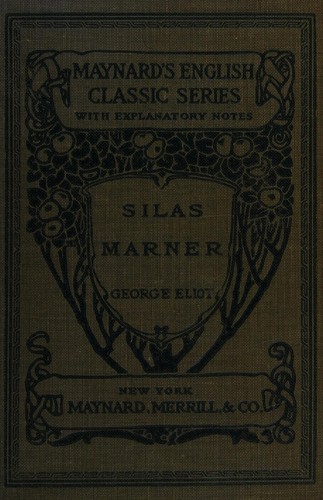
Silas Marner
George Eliot (Mary Ann Evans) (1861)
“A miser's stolen gold is replaced by a golden-haired orphan, and a community becomes the instrument of moral reckoning.”
This page prints on a single page. Use Ctrl+P / Cmd+P.
Silas Marner
George Eliot (Mary Ann Evans) (1861) · 224pages · Victorian Realism · 3 AP appearances
Summary
Silas Marner, a weaver falsely accused of theft by his religious community in Lantern Yard, retreats to the rural village of Raveloe, where he lives as a recluse for fifteen years, hoarding gold coins as his only source of meaning. When the squire's dissolute younger son Dunstan Cass steals Silas's gold and vanishes, the weaver is shattered. On New Year's Eve, a golden-haired toddler wanders into his cottage after her opium-addicted mother dies in the snow. Silas adopts the child, names her Eppie, and through raising her is reintegrated into the Raveloe community. Sixteen years later, Eppie's biological father Godfrey Cass — who had secretly married her mother — tries to claim her. Eppie refuses, choosing Silas and the working-class life she knows. Justice arrives not through courts but through communal moral order.
Why It Matters
One of the shortest and most widely assigned Victorian novels, Silas Marner demonstrated that the moral complexity of Eliot's longer works could be achieved in a compressed, fable-like structure. It remains a cornerstone of British secondary education and a standard text in courses on Victorian l...
Themes & Motifs
Diction & Style
Register: Elevated Victorian prose with extensive authorial commentary, balanced by precisely rendered dialect speech in dialogue
Narrator: Omniscient, essayistic, morally authoritative. Eliot's narrator is the most openly judgmental voice in Victorian fict...
Figurative Language: Moderate
Historical Context
Early 19th-century rural England (set c. 1800-1830), written 1861: Eliot deliberately sets the novel in the recent past — two generations before her own time — to capture a moment when rural England still operated as a semi-autonomous moral community, before indus...
Key Characters
Talking Points
- Why does Eliot open the novel with a sociological essay about itinerant weavers rather than with Silas himself? What does this framing accomplish that a direct character introduction would not?
- The drawing of lots at Lantern Yard is presented as a legitimate method of determining truth. How does Eliot use this practice to critique institutional religion, and what alternative 'methods of knowing' does the novel propose?
- Silas's gold is replaced by a golden-haired child. Is this a coincidence, a divine intervention, or something else entirely? What does Eliot want the reader to believe?
- Godfrey Cass is not evil — he is weak. Is moral weakness more dangerous than active villainy in this novel? Use specific examples to argue your case.
- Why does Eliot make Dolly Winthrop — the least educated character in the novel — its moral philosopher? What is she arguing about the relationship between education and wisdom?
Notable Quotes
“There is no just God that governs the earth righteously, but a God of lies, that bears witness against the innocent.”
“He spread them out in heaps and bathed his hands in them; then he counted them and set them in regular piles.”
“Favourable Chance is the god of all men who follow their own devices instead of obeying a law they believe in.”
Why Read This
Because it asks the question that matters most: what makes a family? Silas Marner strips that question to its essentials — a man with nothing, a child with no one, and a community that slowly decides to care. At 224 pages, it's one of the most acc...