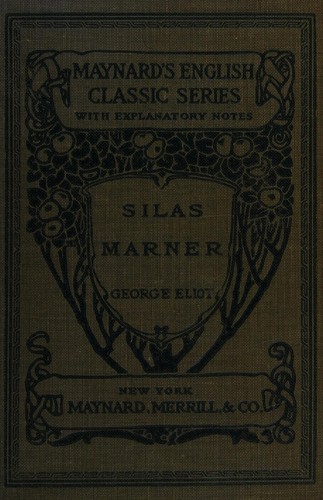
Silas Marner
George Eliot (Mary Ann Evans) (1861)
“A miser's stolen gold is replaced by a golden-haired orphan, and a community becomes the instrument of moral reckoning.”
Language Register
Elevated Victorian prose with extensive authorial commentary, balanced by precisely rendered dialect speech in dialogue
Syntax Profile
Long, elaborately subordinated sentences in narration — Eliot averages 30+ words per sentence, embedding moral commentary within descriptive clauses. The narrator's voice is essayistic, frequently pausing the action for philosophical reflection. Dialogue is sharply differentiated by class: gentry speak in standard English, villagers in phonetically rendered Midlands dialect.
Figurative Language
Moderate — Eliot favors extended analogy and moral metaphor over compressed imagery. Key figurative patterns: gold/light (false treasure vs. true treasure), weaving/threads (connection vs. isolation), gardens (cultivation as moral work), water (concealment in the Stone-pits, revelation through drainage).
Era-Specific Language
Gold coins worth 21 shillings — Silas's hoard and the unit of his obsession
Trance-like seizures — treated as supernatural by villagers, medical by Eliot's narrator
Non-Anglican Protestant congregation — Lantern Yard's rigid, insular faith community
Administrative and spiritual unit of rural England — Raveloe's organizing structure
Weaving apparatus — Silas's livelihood and the rhythmic center of his isolated life
How Characters Speak — Class & Identity
Silas Marner
Initially inarticulate, speaking in short, broken phrases. Gradually acquires the rhythms of Raveloe's communal speech through his relationship with Dolly and Eppie.
Language as a measure of social integration. Silas's expanding vocabulary tracks his expanding world.
Godfrey Cass
Speaks the standard English of the rural gentry — correct, measured, and evasive. Uses passive constructions and indirect phrasing to avoid responsibility.
Class privilege as linguistic privilege: Godfrey can afford to be vague because no one with power will press him.
Dolly Winthrop
Heavy Midlands dialect — 'I' for 'in,' 'allays' for 'always,' 'niver' for 'never.' Speaks in proverbs and practical observations rather than abstractions.
The novel's deepest moral wisdom arrives in its least educated voice. Eliot inverts the Victorian assumption that refined language signals refined thought.
Squire Cass
Bluff, commanding, ungrammatical — the speech of a man who has never needed to persuade anyone of anything because his authority is inherited.
Old rural authority speaks through volume and repetition, not argument. The Squire's language mirrors his governance: loud and undisciplined.
Eppie
Simple, direct, emotionally transparent. Speaks without the evasions of the gentry or the self-consciousness of the educated.
Eppie's clarity of speech reflects her clarity of moral vision — she sees what she knows and says what she sees, without the hedging that marks both Godfrey and Silas.
Narrator's Voice
Omniscient, essayistic, morally authoritative. Eliot's narrator is the most openly judgmental voice in Victorian fiction — routinely pausing action to deliver philosophical commentary, drawing parallels between individual behavior and universal moral principles. The narrator's authority is never ironic or unreliable; it is the voice of mature moral intelligence addressing the reader directly.
Tone Progression
Chapters 1-3
Somber, analytical, sociological
The narrator establishes Silas's isolation with clinical precision. The prose is dense with historical and psychological explanation.
Chapters 4-10
Dual — comic social observation and mounting tension
The Rainbow inn scenes are warmly comic; the Cass chapters are taut with concealed guilt; Molly's death is stark and compassionate.
Chapters 11-14
Warm, domestic, cautiously hopeful
The prose softens as Silas's world expands through Eppie. Eliot's humor becomes gentler, her moral commentary less severe.
Part II (16-21)
Measured, just, elegiac
The reckoning arrives quietly. The prose is patient, unhurried, and ultimately consoling without being sentimental.
Stylistic Comparisons
- Dickens — more sensational, more comic, less psychologically precise. Eliot's moral analysis cuts deeper but entertains less.
- Thomas Hardy — darker, more fatalistic. Hardy's characters are crushed by circumstance; Eliot's are shaped by choice.
- Elizabeth Gaskell — similar social sympathy but Gaskell is warmer and less intellectually rigorous.
- Eliot's own Middlemarch — more ambitious, more populated, but Silas Marner achieves comparable moral depth in a fraction of the space.
Key Vocabulary from This Book
Notable words used in this text — click to see full definitions