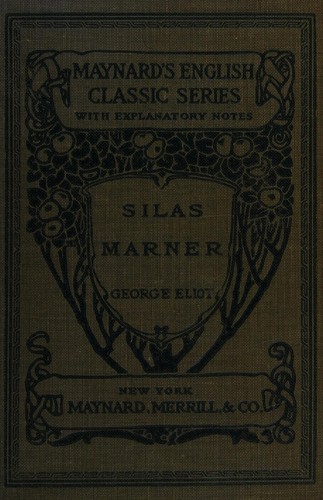
Silas Marner
George Eliot (Mary Ann Evans) (1861)
“A miser's stolen gold is replaced by a golden-haired orphan, and a community becomes the instrument of moral reckoning.”
Silas Marner— Historical Context & Author Background
Author: George Eliot (Mary Ann Evans) · Published 1861· Era: Victorian Realism·224 pages
Themes explored: community, isolation, redemption, gold-vs-love, class, faith, parenthood, justice
About George Eliot (Mary Ann Evans)
George Eliot was the pen name of Mary Ann Evans (1819-1880), one of the most intellectually formidable novelists in the English language. She could not publish under her real name because Victorian literary culture dismissed women writers as capable only of light romance. Before writing fiction, she was a translator of heavyweight German philosophy (Feuerbach, Strauss), an editor of the Westminster Review, and a public intellectual who had lost her Christian faith through rigorous study. She lived openly with George Henry Lewes, a married man who could not obtain a divorce, and the relationship made her a social outcast among the very middle classes she wrote about. Silas Marner was written in a burst of inspiration in 1861, between the massive Adam Bede and the magisterial Middlemarch.
Life → Text Connections
How George Eliot (Mary Ann Evans)'s real experiences shaped specific elements of Silas Marner.
Eliot lost her evangelical Christian faith through intellectual study of biblical criticism and German philosophy
Silas loses his faith through institutional betrayal at Lantern Yard; he recovers a secular, humanistic faith through human relationships in Raveloe
The novel's theological arc mirrors Eliot's own journey from dogmatic religion to a moral philosophy grounded in human sympathy rather than divine authority.
Eliot was socially ostracized for living with Lewes — respectable women refused to visit her
Silas is excluded from Raveloe's community and slowly reintegrated through demonstrated care and goodness
Eliot knew what it meant to be judged by rigid moral codes. Her sympathy for outsiders is experiential, not theoretical.
Eliot grew up in rural Warwickshire and knew the rhythms of agricultural village life intimately
Raveloe is drawn from Eliot's childhood landscape — the dialect, the social hierarchies, the seasonal rhythms are ethnographically precise
The novel's authority as social history comes from first-hand knowledge. Eliot is not romanticizing rural life; she is remembering it.
Eliot translated Ludwig Feuerbach's The Essence of Christianity, which argued that theology is really anthropology — that 'God' is a projection of human needs
The novel replaces divine providence with human community as the agent of moral order. Dolly Winthrop's instinctive faith is Feuerbachian: God is experienced through human care
Silas Marner is Eliot's most accessible dramatization of her philosophical position: religion's value lies not in its metaphysical claims but in the human bonds it fosters.
Historical Era
Early 19th-century rural England (set c. 1800-1830), written 1861
How the Era Shapes the Book
Eliot deliberately sets the novel in the recent past — two generations before her own time — to capture a moment when rural England still operated as a semi-autonomous moral community, before industrialization and urbanization dissolved those bonds. The novel is simultaneously a portrait of that world and an elegy for it. Lantern Yard's replacement by a factory in the final chapters makes the historical argument explicit: the old religious communities are gone, and what will replace them is the question the novel answers through Raveloe's organic, imperfect, but functional moral ecosystem.
Why Silas Marner Matters Historically
One of the shortest and most widely assigned Victorian novels, Silas Marner demonstrated that the moral complexity of Eliot's longer works could be achieved in a compressed, fable-like structure. It remains a cornerstone of British secondary education and a standard text in courses on Victorian literature, the English novel, and moral philosophy in fiction.
- One of the first English novels to dramatize the psychological process of religious deconversion and secular moral recovery
- Pioneered the use of fairy-tale structure within a rigorously realist novel — influencing later writers from Hardy to Murdoch
- One of the earliest novels to present working-class domestic life as morally superior to gentry life without sentimentalizing poverty
Rarely banned or challenged, though occasionally criticized in Victorian reviews for its sympathetic treatment of an unwed mother (Molly Farren) and its implicit critique of institutional religion. Eliot's own scandalous personal life colored reception — some Victorian readers refused to read any work by a woman living in sin.