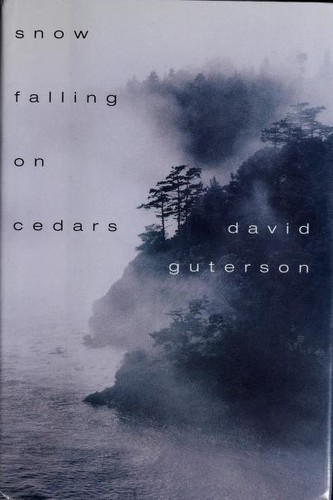
Snow Falling on Cedars
David Guterson (1994)
“A Japanese-American fisherman is on trial for murder in a courtroom where every juror remembers the internment camps. The journalist covering the case once loved the defendant's wife — and holds evidence that could set him free.”
At a Glance
In 1954, on the fictional San Piedro Island in the Pacific Northwest, Kabuo Miyamoto — a Japanese-American gill-net fisherman — is tried for the murder of Carl Heine, a white fisherman found drowned in his own nets. The island community, still scarred by the internment of its Japanese residents during World War II, watches the trial unfold during a massive snowstorm. Ishmael Chambers, the local newspaper editor and a man who lost his arm at Tarawa, discovers evidence that could exonerate Kabuo — but Ishmael once loved Kabuo's wife Hatsue, and his bitterness threatens to override his conscience. The novel braids courtroom testimony, wartime flashbacks, adolescent love, and the silent racism of a small community into a meditation on whether justice is possible when an entire society is implicated in prejudice.
Read full summary →Why This Book Matters
Published in 1994, Snow Falling on Cedars brought the Japanese-American internment to mainstream literary consciousness at a moment when the U.S. government had only recently (1988) formally apologized and authorized reparations. The novel sold over four million copies and won the PEN/Faulkner Award, making it one of the most commercially successful literary novels of the 1990s. It demonstrated that a novel about racial injustice set in the Pacific Northwest — far from the Southern settings that dominated American race fiction — could command a national audience.
Diction Profile
High literary register with naturalistic Pacific Northwest detail — Guterson writes dense, sensory prose that demands attentive reading
High