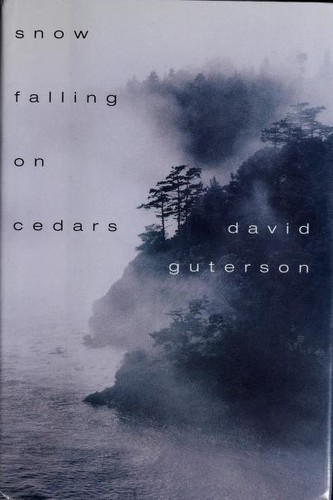
Snow Falling on Cedars
David Guterson (1994)
“A Japanese-American fisherman is on trial for murder in a courtroom where every juror remembers the internment camps. The journalist covering the case once loved the defendant's wife — and holds evidence that could set him free.”
Language Register
High literary register with naturalistic Pacific Northwest detail — Guterson writes dense, sensory prose that demands attentive reading
Syntax Profile
Guterson writes long, accumulative sentences — often 30-50 words — that layer sensory detail and psychological observation in a single syntactic structure. His prose is influenced by Raymond Carver (his teacher at Syracuse) in its attention to the physical world, but expands Carver's minimalism into something closer to Cormac McCarthy's expansive naturalism. He averages 25 words per sentence, with courtroom scenes tightening to 15 and nature passages extending to 40+. Dialogue is spare and realistic, differentiated by character: Ishmael speaks in clipped, guarded sentences; Hatsue speaks with directness and controlled emotion; Nels Gudmundsson speaks in the deliberate cadences of the courtroom.
Figurative Language
High — Guterson uses extended natural metaphors (the snow, the cedar, the sea) as structural symbols rather than decorative figures. His comparisons are drawn almost exclusively from the natural world: feelings are rendered as weather, moral states as landscapes, time as tide. The density increases in the flashback chapters and decreases in the courtroom scenes, where precision replaces poetry.
Era-Specific Language
First-generation Japanese immigrants — born in Japan, legally barred from citizenship and land ownership
Second-generation Japanese-Americans — born in the U.S., citizens by birth, used as legal proxies for land ownership
Japanese term for white people — used within the Japanese community, signals the otherness of the majority from the minority's perspective
A fisherman who uses gill nets — the primary fishing method on San Piedro, central to the plot's mechanics
The 442nd Regimental Combat Team — all-Japanese-American unit, most decorated in U.S. military history
Roosevelt's 1942 order authorizing Japanese internment — the legal instrument that displaced 120,000 people
Internment camp in California's Owens Valley — where the San Piedro Japanese community was confined
A hooked pole used by fishermen — the prosecution's alleged murder weapon
How Characters Speak — Class & Identity
Ishmael Chambers
Educated, literary, self-consciously precise. His narration carries the weight of a man who has read too much and felt too much and cannot stop observing himself observing. Short declarative sentences when bitter; long flowing ones when remembering Hatsue.
A man trapped between his father's moral clarity and his own emotional damage — the language shifts register depending on which self he is inhabiting.
Hatsue Miyamoto
Direct, unadorned, emotionally controlled. She speaks in complete thoughts without qualifications. Her language is the product of both Japanese cultural restraint and personal honesty — she does not hedge.
A woman who has decided who she is and speaks from that decision. Her directness is both cultural inheritance and personal achievement.
Kabuo Miyamoto
Near-silent in the courtroom — speaks mainly through absence of speech. When he does speak, his sentences are formal, military-precise, and stripped of emotion. His inner life is rendered through Guterson's narration rather than dialogue.
The stoicism that the white jury reads as guilt is actually the discipline of a man trained by Japanese culture and American military service to control his expression. His silence is misread because the readers — the jury — lack the cultural vocabulary to decode it.
Nels Gudmundsson
Slow, deliberate, folksy on the surface but precise underneath. He speaks in the rhythms of Pacific Northwest working-class speech — 'well now' and 'I suppose' — that mask legal intelligence.
The defense attorney as everyman: his language disarms because it sounds common, which is exactly what Kabuo needs — a voice the jury recognizes as their own.
Etta Heine
Clipped, judgmental, certain. Her sentences are short and declarative — she knows what she thinks and does not doubt it. No qualifications, no hedging, no self-examination.
The language of unexamined prejudice — confident, concrete, and immune to complexity. Etta never uses a subordinate clause when a declaration will do.
Narrator's Voice
Third-person omniscient with strong free indirect discourse — Guterson moves fluidly between characters' perspectives, inhabiting their thoughts without losing narrative distance. The omniscience is crucial: the novel needs to show what multiple characters are thinking simultaneously, particularly in the courtroom, where the gap between appearance and reality is the central problem.
Tone Progression
Courtroom present (1954)
Measured, tense, procedural
The prose mirrors legal process — careful, qualified, building toward judgment. The tension is sustained through restraint.
Cedar tree flashbacks (1930s-40s)
Lyrical, sensory, elegiac
The most beautiful prose in the novel — Guterson allows himself full romantic lyricism in the memory chapters, which makes their loss register physically.
Internment and war chapters
Documentary, stripped, angry
The prose flattens for the internment — matching the flatness of institutional dehumanization. War chapters are clipped and visceral.
Ishmael's moral crisis
Interior, conflicted, increasingly honest
The prose turns inward as Ishmael confronts his own complicity. Sentences lengthen as self-awareness deepens.
Resolution and snow
Expansive, quiet, accepting
The final pages open into nature writing of great beauty — the snow as final word, indifferent and magnificent.
Stylistic Comparisons
- Harper Lee's To Kill a Mockingbird — same courtroom-as-moral-theater structure, but Guterson denies the reader Atticus Finch's moral clarity
- Cormac McCarthy's The Crossing — similar landscape-as-moral-commentary, similar long sentence structures, similar refusal of easy resolution
- Kazuo Ishiguro's The Remains of the Day — similar exploration of emotional restraint as both cultural discipline and personal prison
Key Vocabulary from This Book
Notable words used in this text — click to see full definitions