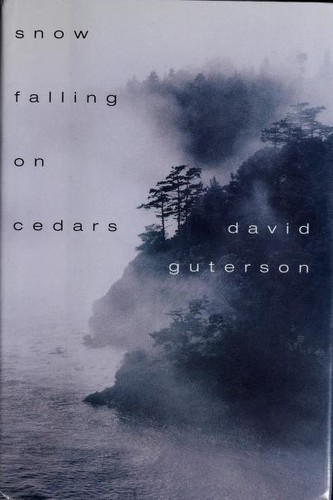
Snow Falling on Cedars
David Guterson (1994)
“A Japanese-American fisherman is on trial for murder in a courtroom where every juror remembers the internment camps. The journalist covering the case once loved the defendant's wife — and holds evidence that could set him free.”
Essay Questions & Food for Thought
30questions designed to challenge assumptions and provoke original thinking. These can't be answered from a summary — you need the actual text.
Ishmael withholds evidence that could free Kabuo. Is his delay a form of racism, personal bitterness, or something more complicated? Can you separate the personal from the political in his decision?
The snow falls continuously throughout the trial. What is the snow doing symbolically? Is it covering truth, equalizing differences, creating isolation, or all three simultaneously?
Guterson chose to make his moral center a white man (Ishmael) rather than a Japanese-American character. What are the consequences of this choice — for the novel's politics, for its emotional range, and for whose story it ultimately tells?
Hatsue tells Ishmael in her letter that their love was not real — that it was the love of children who did not understand the world. Is she right? Can love between people of different races in a racist society ever be fully authentic, or is it always shaped by the structures around it?
Kabuo's stoicism in the courtroom is read as guilt by the white jury. How does cultural misreading function in the novel? Identify at least two other moments where a character's behavior is misinterpreted across cultural lines.
The cedar tree where Ishmael and Hatsue meet is hollowed out — alive on the outside, empty on the inside. How does this physical detail function as a metaphor for their relationship and for the novel's treatment of hidden truths?
Arthur Chambers editorialized against the internment during the war. Ishmael nearly fails to release evidence during the trial. What has changed between father and son — is it character, circumstance, or the difference between abstract principle and personal cost?
The novel braids at least four timelines: the 1954 trial, the 1930s-40s love story, the wartime internment and combat, and the postwar land dispute. Why does Guterson refuse chronological order? What does the braided structure create that linear storytelling cannot?
Etta Heine is never described as racist by any character in the novel. She never uses racial slurs. Yet she is the person whose actions most directly harmed the Miyamoto family. How does Guterson portray racism without villains? Is this portrayal more or less effective than depicting overt hatred?
Compare Snow Falling on Cedars to To Kill a Mockingbird. Both are courtroom novels about racial prejudice, both feature a morally significant white observer, and both are set in communities where structural racism shapes legal outcomes. What does Guterson's novel do differently, and what does it lose by not having an Atticus Finch?
Kabuo served in the 442nd and killed German soldiers in Europe. He carries Buddhist guilt for these deaths. How does Kabuo's war guilt complicate his position as a wrongly accused man? Can a man be innocent of one crime and guilty of another simultaneously?
The land dispute between the Miyamoto and Heine families mirrors the broader history of Japanese-American dispossession. How does Guterson use a private property conflict to represent a national injustice? Is the private story sufficient, or does the novel need to address the larger history more directly?
Ishmael lost his arm to a Japanese shell at Tarawa. He lost his love to a Japanese man. How does the novel treat the relationship between personal wound and political prejudice? Is Ishmael's bitterness toward Japanese people understandable, forgivable, or neither?
The novel ends with snow falling — not with justice delivered, not with a community transformed, not with Ishmael healed. Why does Guterson choose an image of nature rather than an image of human resolution? What does this ending say about the limits of individual moral action?
Hatsue's mother Fujiko warns her daughter against loving a white man. Is Fujiko's counsel wisdom or prejudice? Does the novel validate or complicate her position?
Carl Heine Jr. was considering restoring the seven acres to Kabuo before his death. If Carl had lived and completed the sale, would justice have been done — or would private generosity be a substitute for the public reckoning the community needed?
Guterson describes San Piedro Island in extraordinary natural detail — the cedars, the tides, the fog, the strawberry fields. What is the relationship between the island's beauty and the community's moral failures? Does beauty make injustice easier to overlook?
The prosecution attorney Alvin Hooks never makes an explicitly racist argument. He simply presents evidence in a way that activates the jury's existing racial assumptions. How does this technique mirror the way prejudice operates in real courtrooms and institutions?
Nels Gudmundsson is old, one-armed, and seemingly past his prime — yet he provides the most competent defense in the novel. Why does Guterson make the defender of justice a physically diminished man?
The S.S. West Corona freighter wake — the likely cause of Carl's death — represents accident in a novel obsessed with intention. If Carl died by accident, does the community's readiness to convict Kabuo become more or less damning?
How does the novel treat the 442nd Regimental Combat Team — the Japanese-American soldiers who fought for a country that imprisoned their families? What does Kabuo's service say about patriotism, loyalty, and the paradox of fighting for a nation that has wronged you?
The novel was published in 1994, six years after the U.S. government formally apologized for the internment. How does the timing of publication affect the novel's political work? Would the novel have been received differently in 1964? In 2024?
Ishmael eventually does the right thing — but not immediately, not purely, and not because he has overcome his bitterness. Is a right action done for impure reasons still morally valuable? Does the novel suggest that motive matters less than outcome?
The hollowed-out cedar tree shelters love between Ishmael and Hatsue; the cedars of the island give the novel its title; snow falls on them in the final image. Trace the cedar as a symbol through the entire novel. What does it represent at each stage?
Some critics argue that Guterson sentimentalizes the Japanese-American experience by filtering it through a white romantic's nostalgia. Others argue that the white perspective is necessary to reach white readers and confront them with their own complicity. Which argument do you find more persuasive?
The fishing community of San Piedro depends on the sea for its livelihood, and the sea kills Carl Heine. How does the novel use the ocean — its indifference, its danger, its bounty — as a moral framework? Is the sea a symbol of justice or injustice?
Hatsue chose Kabuo over Ishmael. The novel never suggests this was the wrong choice. How does Guterson handle the romantic triangle without making Kabuo a rival or Hatsue a prize? What narrative choices prevent the love story from overwhelming the justice story?
The novel's title is an image, not a concept: snow falling on cedars. What does it mean for a novel about justice and prejudice to name itself after a natural phenomenon? What does the title promise — and does the novel deliver?
Several characters in the novel carry war trauma — Ishmael from Tarawa, Kabuo from Italy, Hatsue from Manzanar. How does the novel distinguish between these different forms of war damage? Is combat trauma and internment trauma treated as equivalent, or is there a hierarchy?
The novel was criticized for its prose style — some reviewers called it overwritten, others called it beautifully crafted. Read a passage from the cedar tree chapters and a passage from the courtroom chapters. Is the difference in style a flaw or a deliberate technique? When is lyrical prose appropriate and when does it become an obstacle?