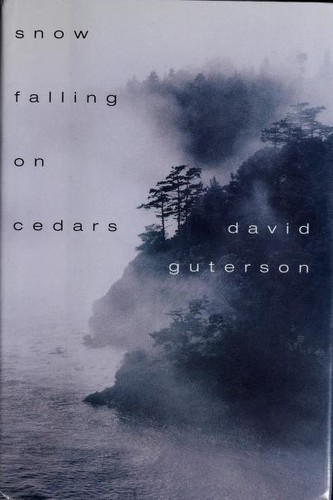
Snow Falling on Cedars
David Guterson (1994)
“A Japanese-American fisherman is on trial for murder in a courtroom where every juror remembers the internment camps. The journalist covering the case once loved the defendant's wife — and holds evidence that could set him free.”
Snow Falling on Cedars— Summary & Analysis
by David Guterson · published 1994 · 460 pages · Contemporary
A user-friendly study guide for Snow Falling on Cedars by David Guterson (1994): a high-level plot summary, full chapter-by-chapter analysis, theme breakdowns, character profiles, and 30 essay questions designed for high-school, ap-english, college readers. Unlike a stock summary, sumsumsum.com adds a diction analysis drawn from David Guterson’s actual text, the 4 documented AP Literature exam appearances of this book, and reading-difficulty guidance (Easy, 3/10) so students, teachers, and lifelong readers know what they are walking into.
“A Japanese-American fisherman is on trial for murder in a courtroom where every juror remembers the internment camps. The journalist covering the case once loved the defendant's wife — and holds evidence that could set him free.”
Short Summary
In 1954, on the fictional San Piedro Island in the Pacific Northwest, Kabuo Miyamoto — a Japanese-American gill-net fisherman — is tried for the murder of Carl Heine, a white fisherman found drowned in his own nets. The island community, still scarred by the internment of its Japanese residents during World War II, watches the trial unfold during a massive snowstorm. Ishmael Chambers, the local newspaper editor and a man who lost his arm at Tarawa, discovers evidence that could exonerate Kabuo — but Ishmael once loved Kabuo's wife Hatsue, and his bitterness threatens to override his conscience. The novel braids courtroom testimony, wartime flashbacks, adolescent love, and the silent racism of a small community into a meditation on whether justice is possible when an entire society is implicated in prejudice.
Detailed Summary
The novel opens in a courtroom on San Piedro Island, a small fishing community in the San Juan Islands of Washington State, in December 1954. Snow is falling. It will fall for the entire duration of the trial, burying the island under a silence that mirrors the community's buried prejudices. Kabuo ...
Summary in the Author’s Writing Style
A retelling of Snow Falling on Cedars in David Guterson’s style — so you can hear the language, not just the plot. This is a stylistic pastiche written by sumsumsum, not an excerpt from the book.
The snow began on the first morning of the trial and did not stop, and it fell on the cedars and on the harbor and on the low gray buildings of Amity Harbor with a patience that seemed almost deliberate, as though the island itself meant to be buried, to lie down beneath that whiteness and forget th…
Chapter-by-Chapter Analysis
If you liked Snow Falling on Cedars, read next
Start with The Remains of the Day by Kazuo Ishiguro — Same exploration of emotional restraint as both cultural discipline and personal prison — Stevens and Kabuo share the tragedy of being misread by those who lack the vocabulary to see them. Then try Beloved by Toni Morrison — Another novel about how a nation's racial crime lives on in the bodies and minds of individuals — Morrison's prose is more experimental, but the moral weight is equivalent. Or pivot to The Joy Luck Club by Amy Tan — Asian-American experience across generations — Tan writes from inside the Chinese-American community where Guterson writes from outside the Japanese-American one.
For comparative essays, pair Snow Falling on Cedars with
The strongest comparative pairing is To Kill a Mockingbird (Harper Lee) — The novel Snow Falling on Cedars most deliberately echoes and complicates — same courtroom structure, same racial prejudice, but without the moral clarity of Atticus Finch. For a third angle, contrast with The Things They Carried (Tim O'Brien) — Similar treatment of war trauma's persistence — both novels understand that combat damage reshapes every relationship and decision that follows.
Each of these pairings opens a clean thesis path on shared themes, period diction, or formal influence — useful for AP Lit / IB / first-year college comparative essays.