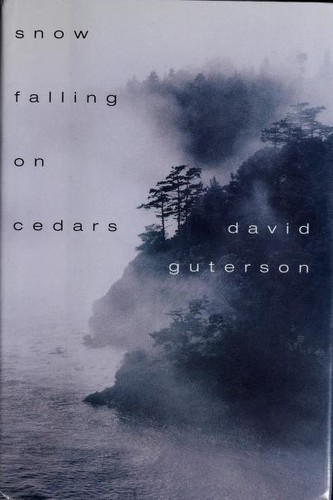
Snow Falling on Cedars
David Guterson (1994)
“A Japanese-American fisherman is on trial for murder in a courtroom where every juror remembers the internment camps. The journalist covering the case once loved the defendant's wife — and holds evidence that could set him free.”
This page prints on a single page. Use Ctrl+P / Cmd+P.
Snow Falling on Cedars
David Guterson (1994) · 460pages · Contemporary · 4 AP appearances
Summary
In 1954, on the fictional San Piedro Island in the Pacific Northwest, Kabuo Miyamoto — a Japanese-American gill-net fisherman — is tried for the murder of Carl Heine, a white fisherman found drowned in his own nets. The island community, still scarred by the internment of its Japanese residents during World War II, watches the trial unfold during a massive snowstorm. Ishmael Chambers, the local newspaper editor and a man who lost his arm at Tarawa, discovers evidence that could exonerate Kabuo — but Ishmael once loved Kabuo's wife Hatsue, and his bitterness threatens to override his conscience. The novel braids courtroom testimony, wartime flashbacks, adolescent love, and the silent racism of a small community into a meditation on whether justice is possible when an entire society is implicated in prejudice.
Why It Matters
Published in 1994, Snow Falling on Cedars brought the Japanese-American internment to mainstream literary consciousness at a moment when the U.S. government had only recently (1988) formally apologized and authorized reparations. The novel sold over four million copies and won the PEN/Faulkner Aw...
Themes & Motifs
Diction & Style
Register: High literary register with naturalistic Pacific Northwest detail — Guterson writes dense, sensory prose that demands attentive reading
Narrator: Third-person omniscient with strong free indirect discourse — Guterson moves fluidly between characters' perspectives...
Figurative Language: High
Historical Context
1942-1954 — Japanese internment, World War II Pacific and European theaters, postwar resettlement: The novel is structured around the gap between America's stated ideals (justice, equality, due process) and its actual treatment of Japanese-Americans during and after World War II. The internment ...
Key Characters
Talking Points
- Ishmael withholds evidence that could free Kabuo. Is his delay a form of racism, personal bitterness, or something more complicated? Can you separate the personal from the political in his decision?
- The snow falls continuously throughout the trial. What is the snow doing symbolically? Is it covering truth, equalizing differences, creating isolation, or all three simultaneously?
- Guterson chose to make his moral center a white man (Ishmael) rather than a Japanese-American character. What are the consequences of this choice — for the novel's politics, for its emotional range, and for whose story it ultimately tells?
- Hatsue tells Ishmael in her letter that their love was not real — that it was the love of children who did not understand the world. Is she right? Can love between people of different races in a racist society ever be fully authentic, or is it always shaped by the structures around it?
- Kabuo's stoicism in the courtroom is read as guilt by the white jury. How does cultural misreading function in the novel? Identify at least two other moments where a character's behavior is misinterpreted across cultural lines.
Notable Quotes
“The accused man, Kabuo Miyamoto, sat proudly upright with a rigid grace, his palms placed softly on the defendant's table.”
“The snow blew sideways across the courtroom windows and collected thickly on the sills.”
“The truth was that no one on San Piedro Island wanted to be the one to sit in judgment, and no one wanted to be the one who walked away from it eit...”
Why Read This
Because this novel shows you exactly how prejudice works when no one thinks they are prejudiced. The people on San Piedro Island are not burning crosses or shouting slurs — they are sitting on juries with assumptions they cannot name, making decis...