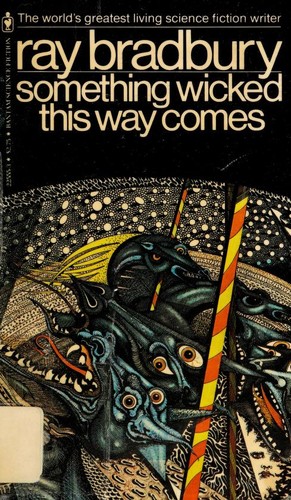
Something Wicked This Way Comes
Ray Bradbury (1962)
“A traveling carnival offers you everything you ever wanted — your youth back, your secret desires fulfilled — and it only costs your soul.”
At a Glance
Two thirteen-year-old boys, Will Halloway and Jim Nightshade, discover that a mysterious carnival has arrived in their small Illinois town one October night. Led by the sinister Mr. Dark, the Illustrated Man, the carnival preys on townspeople's deepest desires — offering youth to the old, maturity to the young, beauty to the plain — but every gift is a trap that enslaves the recipient. When the boys learn the carnival's secret, Mr. Dark hunts them through the town. It falls to Will's father Charles, a fifty-four-year-old librarian who considers himself a failure, to defeat the carnival — not through violence, but through laughter, love, and the radical acceptance of mortality.
Read full summary →Why This Book Matters
Something Wicked This Way Comes is the foundational text of American dark fantasy — the book that proved literary horror could be lyrical, philosophical, and emotionally generous. Before Bradbury, horror in American fiction was either pulp (entertaining but disposable) or Gothic (Poe, Hawthorne — brilliant but psychologically narrow). Bradbury created a third path: horror as a vehicle for exploring what it means to be human, mortal, and afraid. The novel's influence on Stephen King, Neil Gaiman, and virtually every subsequent writer of literary horror is direct and acknowledged.
Diction Profile
Lyrical prose-poetry layered over Midwestern colloquial dialogue — Bradbury writes like a poet disguised as a storyteller
Extremely high