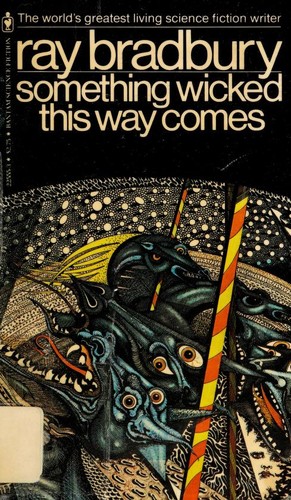
Something Wicked This Way Comes
Ray Bradbury (1962)
“A traveling carnival offers you everything you ever wanted — your youth back, your secret desires fulfilled — and it only costs your soul.”
Language Register
Lyrical prose-poetry layered over Midwestern colloquial dialogue — Bradbury writes like a poet disguised as a storyteller
Syntax Profile
Bradbury's sentences range from single-word fragments ('October.') to paragraphs-long lyrical cascades. He uses repetition and parallelism obsessively — triads, catalogues, anaphora. Dialogue is clipped, Midwestern, naturalistic. Narration is ornate, incantatory, rhythmically driven. The contrast between the two registers creates the novel's distinctive texture: a world that sounds ordinary when people speak and mythic when the narrator describes it.
Figurative Language
Extremely high — Bradbury metaphorizes everything. Seasons are characters, machines are organisms, emotions are weather. The carousel 'breathes,' the carnival 'infects,' laughter 'burns.' His metaphors are consistently synesthetic, blending sensory modalities (the sound of autumn, the color of fear). The density can be overwhelming — Bradbury never uses one image when five will do — but the effect is immersive and dream-like.
Era-Specific Language
The carnival's name — 'pandemonium' (Milton's capital of Hell) plus 'shadow show' (illusion, theater)
Bradbury's term for the carnival's operators — beings who inhabit the dying season, who feed on endings
Steam-organ played at carnivals — the sound that announces the carousel, both festive and sinister
Mr. Dark's title — his tattooed body is a living text of consumed souls
Both literal device and metaphor for drawing danger to oneself — Jim's house attracts the storm
How Characters Speak — Class & Identity
Charles Halloway
Literate, reflective, prone to philosophical digression. His speech becomes more formal when he's thinking hard, more colloquial when he's afraid.
A well-read man in a working-class job — the gap between his inner life and his social position is the source of his self-doubt.
Will Halloway
Simple, direct, earnest. Will speaks in short sentences and asks questions rather than making declarations.
Innocence as a linguistic state — Will's plain speech is both his limitation and his strength. He says what he means.
Jim Nightshade
More adventurous vocabulary than Will, more rhetorical questions, more impatience with explanation.
Jim's language reaches for things beyond his experience — he talks like someone already bored with being thirteen.
Mr. Dark
Formal, courteous, seductive. Perfect grammar, no contractions, the cadence of a salesman who never raises his voice.
Evil as refinement. Dark speaks better than anyone in Green Town — his eloquence is itself a form of power and intimidation.
Tom Fury
Folksy, prophetic, fragmented. Speaks in warnings and riddles, mixing weather prediction with biblical cadence.
The voice of folk wisdom — dismissed as superstition by the modern world, but accurate about the coming storm.
Narrator's Voice
Third-person omniscient but highly subjective — the narrator inhabits each character's consciousness in turn, adopting their vocabulary and emotional register. When the narrator speaks independently, the voice is Bradbury's own: rhapsodic, philosophical, in love with language itself. The narrator is not neutral — it openly admires Charles, mourns for Jim, celebrates Will, and despises the carnival. This partiality gives the novel its emotional warmth.
Tone Progression
Chapters 1-12 (Arrivals)
Ominous wonder, autumnal melancholy
The prose is sensuous and dark — October nights, train whistles, the smell of cotton candy mixed with something wrong. Beauty laced with dread.
Chapters 13-33 (Pursuits)
Accelerating terror, intellectual urgency
The pace increases, sentences shorten, the philosophical passages in the library create islands of calm in a rising tide of danger.
Chapters 34-54 (Departures)
Defiant joy, elegiac resolution
The confrontation chapters are fierce and fast; the resolution chapters are slow and warm. The novel ends at the register it began — lyrical, seasonal, human.
Stylistic Comparisons
- Steinbeck — similar Midwestern cadences, but Bradbury is more ornamental, less restrained
- Poe — shared Gothic tradition, but Bradbury's horror is warm where Poe's is cold
- Dylan Thomas — the closest analogue for Bradbury's prose rhythm, the same love of sound for its own sake
- Stephen King — acknowledged Bradbury as primary influence; King's small-town horror descends directly from this novel
Key Vocabulary from This Book
Notable words used in this text — click to see full definitions